
Africa's Golden City
Season 23 Episode 5 | 55m 15sVideo has Closed Captions
New discoveries reveal how pivotal Great Zimbabwe was to global trade.
Great Zimbabwe was one of the most prominent ancient civilizations of the African continent. Built between the 11th and 15th centuries by ancestors of today’s Shona people, it was the thriving capital of a massive trading empire — but for hundreds of years was dismissed by European explorers. Now, new archaeological discoveries are revealing the true scope of the ancient city's global importance.
Problems playing video? | Closed Captioning Feedback
Problems playing video? | Closed Captioning Feedback
SECRETS OF THE DEAD is made possible, in part, by public television viewers.
Africa's Golden City
Season 23 Episode 5 | 55m 15sVideo has Closed Captions
Great Zimbabwe was one of the most prominent ancient civilizations of the African continent. Built between the 11th and 15th centuries by ancestors of today’s Shona people, it was the thriving capital of a massive trading empire — but for hundreds of years was dismissed by European explorers. Now, new archaeological discoveries are revealing the true scope of the ancient city's global importance.
Problems playing video? | Closed Captioning Feedback
Where to Watch Secrets of the Dead
Secrets of the Dead is available to stream on pbs.org and the PBS app.
Buy Now

Providing Support for PBS.org
Learn Moreabout PBS online sponsorshipThis program contains selected drama reconstruction imagery created with the assistance of generative AI, developed under editorial supervision and informed by archaeological and historical research.
To learn more visit pbs.org/greatzimbabwe -Deep in the heart of southern Africa lies a mysterious set of ruins, the dazzling remains of a once mighty civilization.
-Great Zimbabwe was one of the most prominent civilizations of the ancient world.
It is so stunning.
-The site is larger than Pompeii or Stonehenge.
But the people who built these spectacular structures left no written records.
-Great Zimbabwe was the lost city.
-Yet the ancient past of Great Zimbabwe wasn't lost.
It was stolen.
-The early colonialists who came here said, "This is not African because Africans were incapable of achieving such greatness."
-They stripped the Africans of their identity because it denied them a relationship with their ancestral land.
-We are here to change that.
-Now, an African-led team of archaeologists is uncovering the real story of a medieval African city.
Who built Great Zimbabwe?
And when?
-Great Zimbabwe would have been astonishing to anyone.
It's like flying over New York or London.
-What was life like for the inhabitants?
-Great Zimbabwe had this huge population.
It was alive.
Great Zimbabwe was alive.
-What powered and paid for this vast African metropolis?
-Wow, that's gold!
It's magical.
-And why was it abandoned?
-The people who built Great Zimbabwe did not disappear.
We are still very much alive today.
-It's a civilization history tried to forget.
-We are here to reclaim the history of Great Zimbabwe.
-Can cutting-edge science finally reveal the secrets of this ancient city?
-We are putting together the pieces to tell the correct story.
This is who we are.
♪♪ ♪♪ -Zimbabwe, nation of epic highlands and breathtaking valleys in Southern Africa.
Bordered by the mighty Limpopo and Zambezi rivers and rich in majestic wildlife.
Its savannahs and woodlands cover 100,000 square miles.
At its heart lie the remains of a city.
-Great Zimbabwe is a special place.
One of the wonders of the world.
♪♪ -For one man, this massive site is the source of a lifelong fascination.
-My name is Shadreck Chirikure.
I am Professor of Archaeological Science at the University of Oxford.
I was born in southern Zimbabwe, about 45 minutes from Great Zimbabwe.
When I was growing up, I was surrounded by symbols of Great Zimbabwe.
The conical tower was on our $1 coin.
It was only when I started studying archaeology at university -- that's when I started realizing that there was this very big debate around who built Great Zimbabwe.
Some people strongly believed that Great Zimbabwe was not built by Africans.
I now wanted to know more about this place.
-Great Zimbabwe is 180 miles from the Indian Ocean, in the country's southern region.
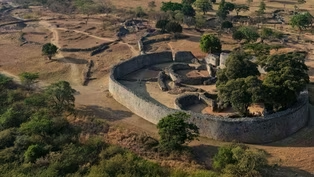
Its vast maze of ruins stretches across 1,800 acres.
To the north, a hilltop complex sits on a central summit more than 250 feet high.
Below it, a web of stone walls creates a network of hand-built compounds.
Surrounding an area more than 300 feet wide, the Great Enclosure is the largest precolonial, man-made structure in southern Africa.
Recent historical research has attempted to date the birth of Great Zimbabwe to around 1300.
At this point in history, medieval Europe boasted thriving cities like Florence, London, and Paris.
But urban enclaves were on the rise all over the world.
-In West Africa, we have the Malian empires.
In East Africa, you have Kilwa, Zanzibar.
Perhaps the most spectacular one in the entire region is Great Zimbabwe.
Even to present day, people visit there.
They must wonder how it just came to exist, because around it, there's absolutely nothing.
Who could have built it?
When?
-The growth of European cities is well-documented in the historical record, but Great Zimbabwe was an oral culture, without written accounts of its history.
And so its origins are harder to trace.
But evidence of the daily lives of the people of Great Zimbabwe can still be found if you know where to look.
Hidden in the earth itself, the clues may answer the questions about this mysterious city that have long gone unanswered.
The archaeologists' goal is to find evidence that tells the real history of this great city.
♪♪ A world authority on Great Zimbabwe, Shadreck is leading a new archaeological excavation to find out more.
The team's first challenge -- determining where on the massive site they should dig.
Instead of the majestic walled enclosures, Shadreck chooses a precarious slope on the side of a steep hill.
Why here?
-This is a rubbish dump.
What we are hoping to find here is a record of what people were eating, and also things that they used every day, so that we can understand how did they live.
[ Indistinct conversation ] -Excavation director Dr.
Russell Kapumha must now dig a trench in this challenging location.
-This is a very steep slope.
So, it becomes very, very difficult to walk on or just to navigate.
♪♪ -Okay.
Right.
♪♪ So, just started the excavating and I just found this tooth.
It could be cow?
It's a decent size.
Yes, that's a pot!
This is local pottery.
It is graphite burnished.
We have literally just scraped the surface, and all of this is turning up.
-Cattle teeth and pottery shards are a promising start.
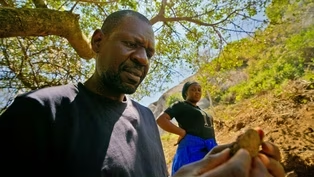
But suddenly, Shadreck spots something unusual.
At first glance, this rock-like lump could be just another fragment of a cooking pot.
But held in the sunlight, it suddenly sparkles.
-There are some tiny pieces of metal.
-Can these traces of metal reveal more about Great Zimbabwe?
♪♪ The University of Oxford's research labs lie 5,000 miles away from Great Zimbabwe.
Here, the team will use cutting-edge science to analyze the recovered artifacts.
Their first challenge -- What are the tiny traces of metal?
-The scanning electron microscope allows us to look at the surface at a very high resolution.
What is of major interest are these very bright things here.
We will soon find out because the chemistry will actually tell us.
So, let's take this little spot here, and -- Oh, wow!
Yeah, this peak here, Au, that is gold.
This is a piece of crucible.
-Designed for purifying metals, crucibles were made of clay and had to withstand the melting temperature of gold, which is nearly 2,000 degrees Fahrenheit.
A metals expert, Shadreck recognizes the pattern of gold droplets as typical of a crucible.
And the shard of clay is the right shape to come from a pot, confirming this is a crucible.
-So, we can see, for sure, that this crucible was used for processing gold.
-Was the gold locally sourced?
Does it explain the existence of this mighty city and its prosperity?
The microscope has also detected other metals.
Could they offer clues about where the gold came from?
-Wow.
This is even more interesting, because we are getting a lot of lead.
Finding lead is a bit of a surprise.
Some of the sources of gold around Great Zimbabwe, about 30 to 50 kilometers to the west, they are associated with lead.
So, this tells us that this gold would have come from those mines.
-The lead is a chemical fingerprint linking the gold to a region west of Great Zimbabwe, where the rocks contained lead as well as gold.
Although the ancient mines are long gone, archaeological evidence reveals they were part of a spectacular regional abundance of gold deposits.
-One great thing about the Zimbabwean plateau is that it is extremely rich in gold.
The mapping of archaeological sites has actually found more than 6,000 pre-industrial gold deposits in the region.
-The crucible reveals that gold was mined nearby, then brought to Great Zimbabwe to be processed.
And fragments from over a hundred crucibles like the one the team has discovered have been found in sites across the settlement, suggesting a massive, city-wide operation.
-People were working gold all over Great Zimbabwe, on the hill, in the valley, and in the surrounding settlements.
So, the size of Great Zimbabwe's gold-working industry was staggering.
-Back at the trench, the team finds another glittering clue.
And this time, Shadreck knows exactly what it is.
-It's gold.
-Oh, wow, amazing!
Wow, that's gold.
Ooh!
William, that's wonderful.
Yeah, it is indeed gold.
This is unmistakably gold.
It does not rust.
It glitters and it's heavy.
And we are very happy to have found this.
Thank you, William!
♪♪ -Shadreck takes the new discovery to a secure location, where items made from gold mined around Great Zimbabwe are kept under lock and key.
-It's magical.
Great Zimbabwe's gold.
These are very, very fine pieces of wire, which would have been used perhaps as a bracelet, or perhaps as a necklace.
This is an intricately made object.
It's very, very beautiful and exquisite.
That's Great Zimbabwe's gold craftsmanship at its best.
-The first chapter in the story of Great Zimbabwe is the sizable role gold played in the spectacular city's growth.
Great Zimbabwe was truly a city of gold.
Plentiful local mineral reserves brought wealth to the city, which explains how it funded its monumental, labor-intensive architecture.
The presence of gold near Great Zimbabwe, and the number of crucibles discovered there, suggests an extensive gold-working industry.
But over the last century, only small amounts of gold have been found in the main enclosures.
Why?
This is the Western Enclosure of the Hill Complex.
The rudimentary brickwork tells archaeologists it's the oldest structure on the site, where Great Zimbabwe began.
Looking at the uneven surface level, it's clear tons of earth have been torn out of the ground.
-So, this depression is a result of excavations in the late 19th century, as well as in the early 20th century.
-Modern mining efforts sliced into the earth, removing huge quantities of potentially evidence-rich dirt.
-They were prospecting for gold in this very enclosure, so the ground level would have been very, very high up.
So, they came here, dug, and then sieved the soil to remove some gold and threw it away.
-Who was responsible for stripping the gold from Great Zimbabwe's soil?
♪♪ In the middle of the 19th century, Africa was mostly populated and ruled by Africans.
But European powers greedily eyed the continent's rich mineral resources.
They began what came to be known as the "Scramble for Africa."
-The Scramble for Africa began around 1880.
Every white settler who was coming to Southern Africa at that time dreamt of one day finding the gold.
-At the Berlin Conference of 1884, France, Britain, Germany, and other European powers met to carve up Africa among them.
By the early 20th century, around 90% of the continent had been seized as colonial territories.
Britain was the controlling power where Great Zimbabwe was located.
Led by diamond mine millionaire Cecil Rhodes, the colony was named Southern Rhodesia.
By the time the British arrived, Great Zimbabwe's most powerful days were long past.
The colonists found mostly unoccupied ruins.
But just the existence of the ruins was a challenge to the entire colonial project.
-The standard European ideology was they were coming into this continent to basically civilize "primitive peoples."
Great Zimbabwe presented a problem -- How could you civilize these people when in fact they had their own civilization?
-The epic structures of Great Zimbabwe bore witness to a sophisticated ancient culture.
In order to justify their occupation, the colonists declared Africans hadn't built Great Zimbabwe at all.
-"It was the Phoenicians.
It was the people from the Bible who had built Great Zimbabwe.
Great Zimbabwe was actually the remains of the Queen of Sheba."
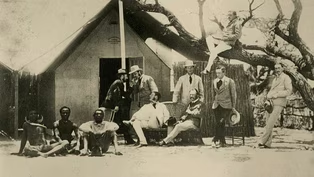
-The British claimed the site's grandeur proved it must have been built by ancient visitors from the Mediterranean or the Middle East.
To support their claims, they sent their own archaeologist to Great Zimbabwe.
Theodore Bent arrived in 1891.
At the Pitt Rivers Museum in Oxford, curator Ashley Coutu reads from Bent's original report.
It explains why Africans couldn't have built Great Zimbabwe and reveals the racist attitudes that lay behind Europe's colonial expansion into Africa.
-So, this text is the report of Theodore Bent.
"From this mass of fresh evidence, we may safely consider that the builders of these mysterious structures were well-versed in geometry and studied carefully the heavens.
It quite excludes the possibility of any negroid race having had more to do with their construction than as the slaves of a race of higher cultivation for it is a well-accepted fact that the negroid brain never could be capable of taking the initiative in work of such intricate nature."
It's very shocking, especially as an archaeologist, reading it.
This passage is shockingly racist.
It really shows the real blindness that Bent and others would have had towards the possibility that local people could have made Great Zimbabwe.
And they have to find another explanation because it can't be that local people have built the site.
-The first white explorers to come to Great Zimbabwe, they have their own preconceived notions about the local population.
They feel these are barbaric, these are backward, and it's unimaginable to them that these people that they look down upon can have anything to do with a structure that's as amazing and magnificent as Great Zimbabwe.
-Soon, amateur British archaeologists and gold hunters descended on the site.
The soil was looted for treasure, and much of the gold was melted down, sold, or brought back to Europe, along with other items that became part of private or museum collections.
The Pitt Rivers Museum houses one of the world's largest collections of global artifacts found in the 19th century.
Much of the treasure of Great Zimbabwe ended up here.
-These are glass beads from Great Zimbabwe.
They are absolutely so tiny, and they're just in amazing colors.
They were taken from Great Zimbabwe in late 19th, early 20th century, by Victorian explorers.
These objects, we do not know exactly where they come from on the site.
So, it really just completely removes it from the last person who touched it and used it.
It's really taking it away from that human context and that human touch, that human kind of connection with that object.
-Treasure hunters and looters tossed out much of the evidence of African occupation at Great Zimbabwe.
Intricate layers of historical material that modern archaeologists would have studied were destroyed, tossed away as trash.
With the grand enclosures stripped of evidence, the team is forced to excavate at sites like the steep hillside.
Here at least, the material is undisturbed.
Clearly, the colonists were wrong.
But if people from other parts of the world didn't build the city, who did?
Typically, archaeologists would study bones to answer this question.
And there is no shortage of them at the trench.
Unfortunately, they aren't the right kind of bones.
-It looks like we have a lot of cattle bones here.
Yeah, all types -- We've got some mandibles, so the jaw bones.
These look like long bones, so from the legs.
So, it looks like we have all parts of cattle.
They're not articulated, so it doesn't look like it was a burial.
This looks like it was possibly a meat feast.
We're already finding, right at the beginning of excavations, tons and tons of cattle bones, thousands of them.
Two by one meter here, and we're getting all these bones, so if we extend that over the whole of the site, I'm assuming there are going to be multiple herds, probably spread across the landscape, and thousands of cattle.
I mean, just so many.
-The massive quantity of bones suggests that, in Great Zimbabwe, cattle were more than just a source of food.
-Cattle was a major source of wealth.
Great Zimbabwe was a great market for cattle.
Dowry, for example, building alliances were based on cows.
When you own a lot of cows, you don't own them to eat them.
They are wealth and they are a bank.
-Great Zimbabwe wasn't just rich in gold.
It was rich in cattle, too, providing a second source of wealth and power.
But these bones provide no clues about the city's inhabitants.
In fact, no human remains have ever been found at Great Zimbabwe.
What happened to the people who lived here?
-No burials have been found here at Great Zimbabwe.
It is not unusual because the archaeology depends on where you dig.
I think it is a matter of time.
People will eventually find them.
-Lacking human remains, the team must search for other evidence of the people who built Great Zimbabwe.
Do the remarkable structures themselves offer any insight?
-This is the Great Enclosure.
This is the most imposing structure here at Great Zimbabwe.
It is six meters wide at the base and 11 meters to the top.
-The Great Enclosure's interior measures more than 60,000 square feet in size.
Its majestic walls were built without mortar and are estimated to be made of more than one million stone blocks.
-What we are looking at here are centuries of developing a building technique that had become so refined.
-For archaeologist Munyaradzi Manyanga, the most important detail is the pattern at the very top of the wall.
-The decoration that you see, which is a chevron pattern, runs especially on this eastern section of the building.
-It's a design that archaeologists have seen elsewhere.
Dozens of other stone structures can be found all over the region.
None are as big as Great Zimbabwe, but they too feature hand-cut, dry-stone walls, terraces, and the distinctive chevron pattern.
Archaeological analysis dates these sites to as early as the 11th century.
They're spread across present-day Zimbabwe and surrounding regions of southern Africa.
They have not been found anywhere else.
Together, these stone structures demonstrate that Great Zimbabwe was not a one-off.
In fact, it was the masterpiece of an African stone-building civilization that spread across the region.
-We like to talk about the Mayan building tradition that today spreads in many nations across Central America.
I think we're looking at something closer to that.
The Great Zimbabwe civilization, visible archaeologically, that in fact inhabits much of the southern half of the continent.
-The hallmark of this great civilization is its monumental dry-stone walls.
Built at least 500 years ago, how were these vast and intricate structures constructed without modern tools?
On the steep hillside, the team finds an answer.
-We are here on the terraces at Great Zimbabwe.
This terrace has collapsed.
If we do not repair it, the whole thing can be dangerous.
-In the first phase of Great Zimbabwe's existence, these terraces were built around the hill.
They created flat, step-like platforms for building houses, which meant the early population could stay close to the defensive stronghold of the Hilltop Complex.
Granite was freely available in the local area, even on the hill itself.
The builders of Great Zimbabwe cut granite stones and skillfully joined the pieces in place, making use of natural features as they went.
Local Shona stone mason Tinashe carefully rebuilds this wall using stones from the original construction.
-We have to make sure the stones are well bonded to avoid collapse again.
The elderly people used to build these structures.
So, I learned from them.
They are skills which are derived from the ancestors.
-Wall-building techniques handed down through the generations are vital to the preservation of Great Zimbabwe.
But they are also a clue to who built the staggering city.
The historical use of local traditions at the site suggests that the indigenous population, not outsiders, built this wonder.
And the team discovers more evidence at the trench to support this theory.
-Wow, look at this!
Ooh!
Amazing.
This is a fragment of a soapstone bowl.
The more complete of these soapstone bowls can be between 50 centimeters and a meter in diameter.
So, these are very big things, which could have been used for ceremonies, which could be used for display.
The tradition of carving soapstone is still alive today, confirming that Great Zimbabwe is Shona in construction.
-The Shona are a Bantu ethnic group who have lived in this part of Africa for more than 1,000 years.
Today, more than half the population of Zimbabwe is Shona.
Soapstone carving remains a widely practiced Shona art form.
-The same traditions that were practiced at Great Zimbabwe then, you still have them in these communities now.
The material culture is very much similar to the material culture that you would find in a normal Shona village, if you go out there today, which is testament to the fact that the people who used to live at Great Zimbabwe, who constructed Great Zimbabwe, the forefathers of the people who are still in the village today.
-Archaeologists have no doubt -- The ancestors of the Shona, not people from the Mediterranean or the Middle East, built Great Zimbabwe.
But in the city's heyday, where did people live?
The only structures to survive are the stone-built enclosures.
But at the trench, Shadreck finds hidden evidence of other buildings here.
-This is clay.
This clay is known as dhaga.
This is the outer side of the house.
And these are the impressions of the wood.
These grooves here, these are the impressions of the poles that held the house up.
-The pole-and-clay building technique used in the ancient city can still be seen today in rural Zimbabwe.
But compared to these modern villages, how big did Great Zimbabwe get?
Evidence from across the site suggests there were thousands of dhaga-built houses.
These remains, together with stone walls and excavations of settlement areas like the new trench, reveal just how large the city became.
From its origins on the hilltop, Great Zimbabwe exploded in size.
Centered around the spectacular Great Enclosure, the city became a massive, interconnected metropolis of houses, stone structures, and farmsteads.
With houses numbering in the thousands, archaeologists are able to estimate population size.
-The population of Great Zimbabwe at its peak would have been between 10,000 and 20,000.
So that was a very big place, which was always bustling.
Great Zimbabwe was one of the biggest concentrations of people in Africa south of the Sahara.
-Great Zimbabwe was a huge urban center with a massive population.
But this raises new questions.
Why did people settle here?
How did they sustain themselves with food and water?
And what transformed a hilltop fortress into an African metropolis?
By now, the trench is nearly eight feet deep.
It's a rich seam, filled with artifacts from across centuries, leading Shadreck to believe they have reached the city's most powerful era.
-We are talking of the period late 14th, 15th century.
We can now say, well, we are getting to the levels when Great Zimbabwe was at its height.
Boom!
Things were happening.
[ Laughs ] -And a discovery sheds new light on the city's explosion in wealth and population.
-I can see this piece, which is greenish.
Uh-oh.
Yeah, here we go.
The green corrosion is a distinctive mark of copper.
I'm looking at a fragment of a copper bracelet, so this greenish metal here is copper, which they cut a very fine wire and wound it round a piece of grass.
Russell?
Here's this copper wire.
Yeah.
-Where did this copper bracelet come from?
Could its presence explain how a small settlement grew into a heavily populated city?
♪♪ Once back in Oxford, Shadreck takes the bracelet for analysis.
-So, I'm setting up a portable X-ray fluorescence machine to analyze the copper from Great Zimbabwe.
♪♪ So, these are the different elements making up the composition of the object.
We can see a very nice and long peak for copper.
And we have something else.
This is tin.
We have a tin bronze.
It was made by mixing or alloying copper and tin.
-The bracelet isn't pure copper.
It's bronze.
Producing it requires expert knowledge and the right ingredients.
-Tin is very rare in nature.
The nearest source of tin that was worked during the time of Great Zimbabwe is located in present-day South Africa, in a place known as Rooiberg.
-Running roughly 500 miles, the trade route from Rooiberg in present-day South Africa would take about a month each way to travel on foot.
South African traders brought tin to Great Zimbabwe, exchanging it for the city's treasures like gold.
Great Zimbabwe wasn't an isolated settlement, but part of a trading network that stretched across southern Africa.
Trade brought wealth, and attracted more people to the city, leading to its huge expansion and booming population.
And another discovery is about to change the picture even more radically.
Archaeologist Muchen Zhou has been examining shards of pottery from the trench.
One grabs her attention.
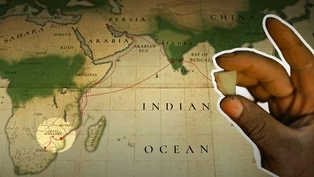
-Ah.
Well, you can see the whitish here, which is the body, and then this glaze, which is apple green.
-This pottery fragment is very different from the earth-brown shards of local pots the team has found so far.
Where did this green pottery come from?
At the Oxford laboratory, Muchen places the fragment in an ultra-high-resolution microscope.
♪♪ The broken edge is rough and textured, but the unbroken glazed surface is incredibly smooth.
For Muchen, it's a significant find.
-This is a glaze and then you can see how uniform it is.
-A glaze of such smoothness requires firing at very high temperatures, over 2,000 degrees Fahrenheit.
There was only one place in the world that could produce these results at the time.
-Only China had the technology and then the engineering to fire at such a high temperature.
So, this one is a high-temperature pottery, produced in southern China.
It's a Longquan celadon.
-Longquan celadon is a famously beautiful style of Chinese pottery known for its jade-green glaze.
Found at Great Zimbabwe, it was produced in the kilns of Longquan in southeast China.
Highly prized, it was traded throughout Europe and the Middle East as a sign of wealth and status.
-It is quite amazing that you find this kind of pottery at Great Zimbabwe.
For such pottery to travel all the way through Southeast Asia, South Asia, and then Persian Gulf, all the way across the Indian Ocean... It has traveled for a very long way.
-As the trench deepens, the team is finding other evidence of international trade, including a large number of glass beads not produced in southern Africa.
Archaeologists have discovered glass items from around the world -- Southeast Asia, India, the Middle East, and regions around Iran.
This African civilization had contact with different groups of people across continents and oceans.
-Great Zimbabwe was a truly global place.
-Soapstone carvings, the remains of houses, and traded items ranging from tin to Chinese pottery, all evidence that Great Zimbabwe was built by ancestors of the Shona people, the city growing as a result of this African and global trade.
But with a population of up to 20,000 people, the sheer size of Great Zimbabwe raises another question.
Much of the surrounding territory is susceptible to drought.
In an era before modern farming techniques, how did the city feed such a massive population?
Archaeologist Munyaradzi Manyanga believes answers may lie in the heart of the Great Enclosure.
-The conical tower is a structure comprising of regularly shaped blocks.
The conical tower is the pinnacle of this architectural achievement here at Great Zimbabwe.
-This emblematic tower is completely solid.
What purpose did it serve?
-This structure is highly symbolic.
Its shape is very similar to the historical grain storage facilities that you find throughout the country.
-Grain storage was critical for survival in Africa.
Today, African granaries still show similarities in design to the conical tower from the past.
But what was stored in these granaries?
Where were the fields and water supplies?
And how did they grow enough to feed up to 20,000 people?
An object emerges from the excavation that might answer those questions.
-What have we got and where have we got it?
Oh, wow, it's an amazing pot!
We didn't know we were going to find this big pot.
-In over a century of digging, it's the largest pot ever found at Great Zimbabwe.
-Because this is a very big pot, we need to try and remove it as intact as possible.
-Vessels like this were used by individuals for storing grain.
-There you go.
-So it's likely the trench contains fragments of what people in Great Zimbabwe ate.
But spotting a single kernel of grain is much harder than finding gold.
♪♪ In Oxford, archaeobotanist Dr.
Alice Williams has soil from the Great Zimbabwe trench and a novel way to separate it from other material.
-So, soil like this, it's really hard to tell what's in it.
We use water as a really simple method to recover the organic material.
-The water washes the soil away, leaving tiny pieces of organic matter that can be analyzed.
-We systematically sampled throughout the trench so we're getting a level of information that we haven't had from Great Zimbabwe before.
♪♪ Just trying to get it into focus.
Alright, so lots of bits of wood charcoal.
You can tell it's wood charcoal because it's slightly shinier and will have these long lines in the side.
Ah!
There's a grain.
Look at that.
This is really well-preserved.
Great, we'll put that in separate dish.
Oh, there's another bit.
This one looks a bit more, um, well-cooked.
It's a great sample.
Yeah, this is going to be a good one.
-An expert on the plants of Africa, Alice identifies the grain she has discovered -- sorghum.
-Sorghum is a really interesting grain.
It's like wheat.
It is one of the most important grains grown in the world today, even though we haven't heard of it in Europe as much.
Sorghum is a nutritious grain full of vitamins and minerals and a good amount of protein.
This would have given people a lot of energy.
-A calorie-dense crop would have been important for the residents of a bustling city like Great Zimbabwe.
But is that the only reason they grew sorghum?
-You also have to ensure that the crops are resilient.
And sorghum is a drought-resistant crop.
So, sorghum would have been a great crop to grow in the region because it's very good at growing in low rainfall conditions and we're finding a lot of it, so they must have been growing sorghum.
-Sorghum's drought resistance makes it perfect for any dry periods that might have affected Great Zimbabwe.
Archaeological evidence of sorghum has been found all over Great Zimbabwe, suggesting a broad system of cultivation that supported the city.
Archaeologists also believe the favorable climate and terrain helped provide crucial sources of water.
Summer rains were collected and stored, local rivers supplied water and grazing grounds, and the granite landscape contained natural underground reservoirs that preserved water year-round.
Great Zimbabweans were able to maintain food and water security, enabling the city to grow and flourish, part of an ideal set of conditions that, when taken together, made this extraordinary African city possible.
Rich local resources, extensive African and intercontinental trade networks, a massive gold-working industry, and an ideal valley location -- Supported by these conditions, Great Zimbabwe grew and prospered for centuries.
-At its peak, the sheer size of Great Zimbabwe will have been astonishing to anyone.
It's like flying over New York or London.
Great Zimbabwe was a global city.
♪♪ -What would this global city have been like for the people who called it home?
-If you look at today, Great Zimbabwe, it looks abandoned.
This would not have been the Great Zimbabwe during the 13th and 14th centuries.
It was alive.
Great Zimbabwe was alive.
There would be men busy with their crafts, women preparing meals and processing grain.
There were children playing around, music, dance.
-Today, Shona people still practice the same cultural traditions that once animated Great Zimbabwe.
-Shona people, as part of their religion, they perform ceremonies associated with thanksgiving.
There are echoes of that spirituality in communities today.
People still offer thanksgiving ceremonies, invite relatives and friends, and enjoy, whilst they are thanking the ancestors.
-We must imagine people being part of this place.
It must have been exciting to be here.
♪♪ -From the 14th to the 15th centuries, Great Zimbabwe was, at its height, the largest and most powerful city-state in Southern Africa.
And yet the archaeological record reveals that, slowly, things began to change.
-In certain areas where excavations have been conducted, one notices an abrupt end to human occupation.
Post-17th century, we seem to have a decline in the number of people living here.
-By the time colonists arrived in the 19th century, the site was, as one of them wrote, "a mass of ruins."
What happened?
-What seems to have been the case is that the massive population was becoming too much for the kind of restricted space at Great Zimbabwe.
If you're looking at 20,000 people concentrated at just one point, it is very clear that that would have created numerous problems.
It doesn't seem to have been designed to accommodate a huge population.
-Despite relying on drought-resistant sorghum, archaeologists believe dry conditions and over-farming may have contributed to the decline of the city.
-Increasing droughts, too many people on the landscape, the pressures on farming, would also have persuaded some people to move elsewhere, to look for better lives.
-A combination of factors likely led to Great Zimbabwe's decline.
But as the team reaches the end of its excavation, there's a final question they are still determined to answer.
Doubts remain about when the city was founded.
Some recent researchers have suggested a date of 1300.
Can the team finally say when Great Zimbabwe was first settled?
Across the dig, they have collected organic matter like bones and charcoal, which they believe will provide important information.
In Oxford, technicians combine the material recently collected with other organic finds and subject them to radiocarbon dating, which will reveal the city's earliest human habitation.
But can they pinpoint when the city itself was founded?
-We are looking at radiocarbon dates for Great Zimbabwe.
All of them new, from the lowest layers, which is some of the earliest occupation.
It used to be thought that Great Zimbabwe started around 1300 AD.
What these dates tell us is that Great Zimbabwe started just after AD 1000.
We have moved back by 300 years.
-The new discovery means Great Zimbabwe is three centuries older than recent studies suggested.
Its influence as an African population center and trading hub was even greater than some earlier archaeologists had thought.
-This is the evidence we have been hoping for.
Now is the time to make the story and to be excited about new narratives for Great Zimbabwe.
-This is big time.
This discovery that Great Zimbabwe is in fact 300 years older than we previously thought basically means it was a much greater civilization.
It covered a much larger area.
It's not wrong to call it the Greater Zimbabwean civilization that you can trace from the Indian Ocean all the way to the Atlantic.
♪♪ -In April 1980, after nearly a century of colonial and white minority rule, the British flag was lowered in Rhodesia for the final time and a new, independent African nation was born.
In the fight for independence, an archaeological site became central to the struggle for a new national identity.
-African nationalists were able to rally people for the liberation struggle, using Great Zimbabwe as a rallying point to say, "That's our city.
That belongs to us and we need to fight for that."
-The new nation needed a new name.
Citizens were inspired by the ancient city, naming the country Zimbabwe.
-Great Zimbabwe is derived from "Zimbadze Mabwe," meaning "houses built of stones."
So that becomes the Zimbabwean identity.
Zimbabwe now identifies itself as people who are known for building houses using stones.
-The new country also needed a national symbol.
An image of a carved statue of a bird, found at Great Zimbabwe, was proudly added to the new national flag.
-If you look at our national teams, which travel all over the world, they carry that bird.
It has become a symbol for the nation.
[ Crowd cheering ] -Over a century ago, a racist ideology declared that Great Zimbabwe couldn't have been built by Africans.
These ideas cast a long shadow.
But finally, a new generation of Zimbabwean archaeologists is taking back Great Zimbabwe's story, proving the city was built by ancestors of the contemporary Shona people, not outsiders.
-Great Zimbabwe is African in origin and of great antiquity and a civilization.
-Their discoveries have shown how its inhabitants forged a civilization of truly global significance... -Great Zimbabwe was in fact more magnificent than we have ever imagined.
-...a civilization that did not disappear, but lives on in the local people today.
-Great Zimbabwe, it's more than just an archaeological site.
The people of Great Zimbabwe are very much alive today in contemporary Zimbabwe.
-It brings a sense of pride in terms of what was achieved here.
-The lost city of gold has finally found the people to tell its story.
For them, it's just the beginning.
-Great Zimbabwe is not the only site whose history has been confiscated through colonialism.
Reclaiming Great Zimbabwe and reclaiming the past is also about reclaiming identity.
My hope is that Great Zimbabwe will inspire those places throughout the world to reclaim their own stories erased by colonialism.
♪♪
 New
NewChinese Pottery Reveals Great Zimbabwe’s Global Trade Network
Video has Closed Captions
Clip: S23 Ep5 | 3m 17s | Chinese pottery fragments reveal Great Zimbabwe’s far-reaching global trade network. (3m 17s)
The Colonial Myths Behind Great Zimbabwe
Video has Closed Captions
Clip: S23 Ep5 | 2m 32s | Racist colonial reports denied that Africans built Great Zimbabwe. (2m 32s)
A Mysterious Discovery at Great Zimbabwe
Video has Closed Captions
Clip: S23 Ep5 | 2m 7s | Discover a mysterious find that could reveal how people lived at Great Zimbabwe. (2m 7s)
Preview | Africa's Golden City
Video has Closed Captions
Preview: S23 Ep5 | 30s | New discoveries reveal how pivotal Great Zimbabwe was to global trade. (30s)
Providing Support for PBS.org
Learn Moreabout PBS online sponsorship












Support for PBS provided by:
SECRETS OF THE DEAD is made possible, in part, by public television viewers.