
Is the world more dangerous after the Iran war?
Clip: 6/19/2026 | 5m 35sVideo has Closed Captions
Is the world more dangerous after the Iran war?
Iran appears to be significantly degraded as a military power, but its agreement with the U.S. could open new revenue streams for the regime. The panel discusses how North Korea or China could interpret the behavior of the United States and President Trump over the past three months.
Problems playing video? | Closed Captioning Feedback
Problems playing video? | Closed Captioning Feedback
Major funding for “Washington Week with The Atlantic” is provided by Consumer Cellular, Otsuka, Kaiser Permanente, the Yuen Foundation, and the Corporation for Public Broadcasting.
Is the world more dangerous after the Iran war?
Clip: 6/19/2026 | 5m 35sVideo has Closed Captions
Iran appears to be significantly degraded as a military power, but its agreement with the U.S. could open new revenue streams for the regime. The panel discusses how North Korea or China could interpret the behavior of the United States and President Trump over the past three months.
Problems playing video? | Closed Captioning Feedback
Where to Watch Washington Week with The Atlantic
Washington Week with The Atlantic is available to stream on pbs.org and the PBS app.
Buy Now
10 big stories Washington Week covered
Washington Week came on the air February 23, 1967. In the 50 years that followed, we covered a lot of history-making events. Read up on 10 of the biggest stories Washington Week covered in its first 50 years.Providing Support for PBS.org
Learn Moreabout PBS online sponsorshipAll of this raises this big question.
Is is the world more dangerous now than it was before February 28th when this war started?
I want you all to answer that question.
Well, I I I mean I I think you can make an argument that that Iran has been significantly degraded as a military power.
So in the But can it rebuild?
And and and I mean it's going to have the means, the financial means to rebuild.
China and Russia interested in helping it's uh I mean it's going to have its own it's going to have new revenue streams whether or not I mean I I I don't know the answer to those questions but but it will have the means to rebuild but for right now for the short term maybe the midterm you can argue that Iran is a diminished power and has less of of an ability to inflict harm on on its neighbors.
Uh but these larger questions about whether or not they can rebuild, how quickly they can rebuild, their missile capabilities, their drone capabilities, which haven't really been degraded very much, and ultimately a nuclear program.
I thought it was striking to look at the agreement and refer to the it refers to the Islamic Republic of Iran's nuclear needs.
I it it's acknowledging it seems to me that they will at some point have a right to continue to enrich uranium something that had been you know a red line for Trump at the beginning of this Nancy expand this out a little bit if you're North Korea which has appetites mainly for South Korea if you're China that has an appetite for Taiwan how are you looking at the behavior of the United States United States president over the past three months and how are you how are you interpreting that and what are you learning?
So for China watching um in terms of Taiwan, I think they're seeing the United States has been depleted in terms of its airmunition capability.
Its navy has really taken the brunt of um the war fighting by the United States.
We've had um carriers and destroyers in the region.
And so I think they're watching that and might assess that the United States is weaker in terms of responding to threats to Taiwan.
I think broadly the international community is looking at what happened not only in Iran but in Ukraine and seeing that this idea of sort of large powers coming in and definitively defeating other weaker nations is not necessarily the case anymore.
That technologies become such an an equalizer on the battlefield.
And so I think you're going to see militaries across the world, including the United States, look at their technological capabilities, look at their drone capabilities, look at AI, and figure out what advances they need to make given this rapid moving and changing battlefield dynamic.
Right.
Um, David, uh, you can answer that question if you want, but I want to add something to the mix.
I want to talk about Trump's relationship with Benjamin Netanyahu.
Um, as Henry Kissinger once said, as you know, uh, it may be dangerous to be America's enemy, but to be America's friend is fatal.
Did Did Trump just play Netanyahu for a soccer here?
I think that President Trump came to realize that Netanyahu may have been playing him at the beginning and reacted to this.
Listen, Israel and the United States went into this war together, right?
Right.
They attacked Iran simultaneously.
They discussed how much they had a common interest in it.
They left the war deeply separated with the president having had shouting matches with Netanyahu and so forth.
Why?
Because their interests diverged.
Netanyahu still wanted to go defang Iran and didn't think that they had accomplished that.
President Trump said something really revealing, I thought, when he was in Europe twice.
He mentioned a predecessor of his in the Oval Office who most American presidents don't discuss, Herbert Hoover, and he said, "I don't want to become that Herbert Hoover guy."
So, basically what he was saying was we were headed to a position of energy disruption and of recession and maybe depression, he said, and he had to pull the plug on that, which tells you he was endorsing the Iranian strategy.
Why didn't he think of that beforehand?
really good question and the when historians look back at this at this misbgotten uh adventure, I think the question they will be asking is what was it about the Trump structure here that led them to anticipate so few of the counter moves that Iran made.
Right.
I I I I think if I can just jump I think the answer here is that Trump had a belief in his own invincibility.
It was driven in part by the incredible success in relative ease of the Venezuela operation to get rid of Maduro.
It was driven by the success of the bombing last summer of the nuclear sites and even of the bombing of the of the boats in the Caribbean.
He thought he can do anything, right?
Kareem, last 25 seconds to you.
World more dangerous?
I think it is more dangerous because the lesson that Iran learned uh in the last four months is that you you gain concessions from the United States by punching back at them hard by closing the straight of Hermuz by attacking your neighbors.
And unfortunately, I I don't think thisou has resolved the nuclear issue.
I expect that Iran is actually going to try to acquire nuclear weapons.
Well, on that happy note, we're going to have to leave it there.
Um, I want to thank our guests for joining me and I want to thank you at home for watching us.
You could read Kareem and Nancy on Iran by visiting the atlantic.com.
I'm Jeffrey Goldberg.
Good night from
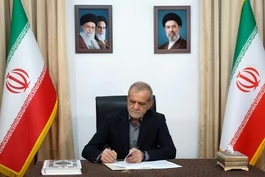
How Iran benefits from Trump's deal and what's next
Video has Closed Captions
How Iran benefits from Trump's deal and what's next (18m 12s)
Providing Support for PBS.org
Learn Moreabout PBS online sponsorship New Episode
- News and Public Affairs

Top journalists deliver compelling original analysis of the hour's headlines.
 New Episode
- News and Public Affairs

FRONTLINE is investigative journalism that questions, explains and changes our world.

 New Episode
 New Episode
 New Episode
 New Episode
 New Episode
 New Episode
 New Episode
Support for PBS provided by:
Major funding for “Washington Week with The Atlantic” is provided by Consumer Cellular, Otsuka, Kaiser Permanente, the Yuen Foundation, and the Corporation for Public Broadcasting.