
Rhode Island PBS Weekly 6/4/2023
Season 4 Episode 23 | 27m 44sVideo has Closed Captions
An in-depth conversation with an ER doctor on COVID’s front lines.
An ER physician shares with Rhode Island PBS Weekly the trials and tribulations of working on COVID-19’s front lines. Then, a second look at the life of William Henry Wilson, cartoonist for the nationally syndicated comic “Wallace The Brave.” Finally, we return to Rose Island, where a professor is catching birds in the name of science
Problems playing video? | Closed Captioning Feedback
Problems playing video? | Closed Captioning Feedback
Rhode Island PBS Weekly is a local public television program presented by Ocean State Media
Rhode Island PBS Weekly 6/4/2023
Season 4 Episode 23 | 27m 44sVideo has Closed Captions
An ER physician shares with Rhode Island PBS Weekly the trials and tribulations of working on COVID-19’s front lines. Then, a second look at the life of William Henry Wilson, cartoonist for the nationally syndicated comic “Wallace The Brave.” Finally, we return to Rose Island, where a professor is catching birds in the name of science
Problems playing video? | Closed Captioning Feedback
How to Watch Rhode Island PBS Weekly
Rhode Island PBS Weekly is available to stream on pbs.org and the free PBS App, available on iPhone, Apple TV, Android TV, Android smartphones, Amazon Fire TV, Amazon Fire Tablet, Roku, Samsung Smart TV, and Vizio.
Providing Support for PBS.org
Learn Moreabout PBS online sponsorship(bright music) - [Announcer] Tonight on "Rhode Island PBS Weekly."
- In one of the hospitals I worked in, there were colleagues that died, and the emails we received from our hospital was not so much having some sort of memorial or acknowledgement of the deaths of our colleagues, but just simply reminding us not to speak with the news media about those deaths.
- [David] He's a wine merchant by day with talent and big dreams, who hopes someday to be the Charles Schulz of Rhode Island.
- I would never tell anybody that, but it's obviously in my head, but it's the day-to-day is just getting the comic out the door.
I was like two years ahead of my daily deadline, and then I had two kids and now I'm like three weeks ahead.
(David and William laugh) - So when the Carolina wren begins to show up in Rhode Island several years ago, that's a signal that climate change is having an effect.
(bright music continues) - Good evening, Welcome to "Rhode Island PBS Weekly."
I'm Michelle San Miguel.
- And I'm Pamela Watts.
So far, more than 103 million Americans have been diagnosed with COVID-19, and more than a million of them have died from the respiratory illness.
- COVID-19, of course, is now well known by all, but back in January of 2020, little was understood about the virus.
At that time, doctors and hospital staff on the front lines became overwhelmed with the rapidly growing pandemic.
Tonight contributing producer, Dorothy Dickey, examines the enduring impact of the early days of COVID through the eyes of one doctor.
- When COVID hit in the spring of 2020, I was in New York City, so I was practicing in two different institutions, (siren blaring) both in Manhattan and in Queens, New York.
We were pretty much inundated with patients, a lack of information and a fast-moving virus that was killing our patients and our colleagues.
And the normal sources of information that we relied on were generally delayed.
By the time we would see something, and we'd look to our hospitals or the CDC for information, that information was one or two weeks behind what we were seeing on the ground, so we really relied on what was a more informal social network of colleagues, ER physicians that we knew, that I trained with in residency that were now dispersed around the country.
And we had a text message thread between the 15 of us, because we couldn't rely on so many formal outlets, we had to rely on each other.
What are you seeing?
How are you treating this?
How is your hospital dealing with this?
And trading that information really became a lifeline for keeping us up-to-date on what we were seeing and how to deal with it.
The telling us not to wear masks in the hallways, because we're scaring the patients.
Are you guys wearing N95's for evaluating each rule-out case?
We're being told just to use surgical masks unless doing an aerosolizing procedure.
There's clearly no real plan.
There was a lot of physicians and providers across the country that were actively told not to wear masks in the early stage of the pandemic.
And the idea in the early stage of the pandemic was that we would scare the patients away, which always sounded funny to me, because wearing masks should reassure patients that we're taking all the steps to protect them.
And yet, many hospital administrators across the country took the opposite tone.
(somber music) (somber music continues) It makes me so angry the lack of state and federal planning.
Why are clowns representing us?
The testing situation is bananas.
(phone notification chimes) I haven't been scared of the virus as a pathogen, I've been scared, because it seems like no hospital administrator knows what's going on.
Anybody have any good news regarding any of the patients they have admitted with COVID so far?
I stopped following up, to be honest.
None.
Yeah, same.
Guys, is it bad to use work health insurance for a psychiatrist or therapist?
I'm gonna need actual help to deal with this.
That is pretty clear to me already.
There was a lot of trauma in those early days.
(siren blaring) I think, inevitably, the shear morbidity we were seeing, we were seeing patients get very ill, seeing patients die, seeing colleagues die because of their infection with COVID in those early stages, and that takes a toll inevitably among anyone that's witness to that.
I do think there was a particular twist to this early stage of COVID that made many of us particularly prone to that trauma, and it was the general sense that our institutions and our hospitals were asking us to take this step forward, put this effort in and put ourselves at risk to help our patients and our community, which we were glad to do.
But at the same time, there was the sense that our hospitals were not meeting us halfway and contributing to our protection.
And in one of the hospitals I worked in, there were colleagues that died, and the emails we received from our hospital was not so much having some sort of memorial or acknowledgement of the deaths of our colleagues, but just simply reminding us not to speak with the news media about those deaths.
Things like that send a message that the hospital might be caring about something different than what we're caring about on the ground when we're trying to deal with these patients and see these very difficult cases.
And I think that's what contributed to a lot of people feeling the way that they did with that acute trauma in those early stages of COVID.
(somber music) (somber music continues) There was a lot of people that had never sought mental health care prior to this, that in this moment felt that they needed to.
As much as we might have lost some trust in our institutions in that moment, there was a widespread amount of community support.
There was offerings of mental health support for ourselves and each other from mental health professionals that said, "Hey, we can't work in an ER, but what we can do "is support our ER colleagues during this time."
And they often donated their time and offered free mental health care for those of us who felt that we needed to.
And I had never pursued mental health care in my life until that moment where someone offered it more casually, and I took them up on it.
And for me, I could say yes, it was tremendously beneficial in that moment of acute stress to be able to speak with someone about it.
(siren blaring) We often see very sorted and morbid things in the emergency room, and for whatever reason, given the culture of medicine, we simply don't discuss them.
We don't bring them up, and we just move along with our lives.
I think a lot of people view that as a coping mechanism.
They might think that if we dwell on this stuff, if we think about it too much, it'll paralyze us.
We have to see these things.
We have to move on in our jobs.
I think these things need to be discussed.
Failing to discuss them doesn't make them go away, and it's something that we often do too little of.
(gentle music) - [Healthcare Worker Voice-Over] I can save them, but who saves me?
It feels impossible to keep up.
What if I get my kids sick or my parents?
- I think we need to remember that 60% of emergency medicine physicians report being burnt out in this moment, three years out of the pandemic.
If one person has a problem, we could say, "Well, that person has an issue."
But if a community has a problem, we can't say that the community has an issue, we must say that there's a systemic problem going on within that community that we must address.
I've dealt with burnout in many ways.
I wrote this book first and foremost, which helped me process a lot of the thoughts and feelings I had during those moments, and it was tremendously beneficial to me.
But I also, I found it very important to work for a hospital for which I felt supported.
Working in a place where you feel supported, I think goes a tremendous long way to helping with any issue of burnout.
There's many hospitals throughout this country, given our healthcare system, that allow people to go on feeling unsupported.
I made it an important point for me to go and seek one out that I thought would be a supportive place, and I did find one.
But I had to go from New York City to New Hampshire to make that happen, and not everyone has that option.
The hospital that I'm working at now is Concord Hospital in Concord, New Hampshire.
(somber music) (somber music continues) - I have long believed that healthcare is a right for all, not a privilege for the lucky few, and this Congress is putting that belief into action.
- So in 2019, I did testify in Congress in the House Rules Committee at the Nation's first Medicare for All hearing.
My name is Farzon Nahvi.
I'm an emergency medicine doctor in New York City, and I support Medicare for All.
And it was the first formal exploration by our Congress into the waters of Medicare for all.
Obviously, there's a hot political issue that people have many different thoughts on, but I'm heartened by the idea that it's now being formally considered and discussed in a way that it wasn't before.
But 45% of Americans live in fear that a health event could lead to bankruptcy.
But I see these numbers every day on the ground level.
I have to look these patients in the eye.
COVID was a tremendous wake up call from which we certainly woke up and learned a lot of things, but sometimes it seems like we fell back asleep.
(chuckles) We learned a lot during that time.
We learned that to protect one another, we have to provide more access to care.
We're all at risk if some of us are at risk.
We're right now, right back in the system that we were before COVID ever happened.
And yet, patients, doctors, politicians, we haven't changed our system at all from what it was prior to COVID.
It serves as kind of a clarifying lens to show us, hey, these things were strange and tragic during the pandemic, but if you take a step back and think about it, (siren blaring) if we're saying that our healthcare system provided untrustworthy institutions during the pandemic, well the truth is they're doing the same all the time during regular periods of life.
Our patients often fail to come to the emergency room when they feel that they need to, because they're worried about the cost.
These things are normal parts of our healthcare system in our society that are not normal parts of other people's healthcare systems and societies across the world.
We often talk about the supply of healthcare workers coming through the system.
What we fail to acknowledge is how many people are leaving the system.
And I think that departure from our healthcare system is largely incumbent on people feeling unvalidated, unsupported by our healthcare system.
(people clapping) - [Reporter] After two weeks at home, recovering from COVID-19, (gentle music) Dr. Paul Saunders gets a hero's welcome back at the hospital.
- And I think we could go a long way in retaining the staff we already have if we showed more respect for the people within the field and more support by our hospitals and our hospital administrators.
I think currently what we're doing is we have a barrel full of water.
There's a huge puncture at the bottom where all this water's leaking out, and we're just trying to fill it from the top.
I think another way to do that is to patch that hole up, so people aren't leaving all the time.
Workers are there, because they want to do their job, they want to help people, but it's tremendously difficult to do that job when they feel unsupported in the process.
(bright music) - Next up, "Peanuts" cartoonist Charles Schulz offered this piece of advice to the next generation.
"Learn to laugh at yourself."
Rhode Islander, Will Wilson, has taken that lesson to heart.
His syndicated cartoon appears in more than 100 newspapers nationwide, but as David Wright first reported last year, "Wallace the Brave" takes its inspiration closer to home in Southern Rhode Island.
(child laughs) - Ah!
(laughs) (child babbles) - [David] Father and son dockside, enjoying a bit of mischief in Jamestown, just across the water from Newport.
It's exactly the sort of scene you might find in the comic strip, "Wallace the Brave," set in a mythical seaside village called Snug Harbor.
- Ah, well, I'm sure as most Rhode Islanders know, there is an actual Snug Harbor a little south of where we are in Jamestown.
And I grew up in Matunuck, and I love Southern Rhode Island, but Snug Harbor, the name always had a nice ring to it.
So I thought it would be appropriate for a quaint little seaside town.
- [David] That's William Henry Wilson.
Like some of the great comic book superheroes, he has a secret identity.
- $21.72.
- [David] By day, he owns and operates Grapes and Gourmet, a local wine shop, but he's also a nationally syndicated cartoonist under the pen name Will Henry.
What pays the bills, the comic strip or the liquor store?
- It's the comic strip now, which is, it's a dream come true.
But the liquor store was kind of an opportunistic endeavor.
I was working here in my early 20s, and the owner was very nice, it went up for sale.
He lived in Arizona, didn't really want to be here anymore, and he offered it to me at a discount price, and I took advantage of that price.
(laughs) - [David] Excellent.
- And because I was trying to do cartoons, I brought my drawing desk down here.
- [David] That little drafting table under the wine rack, his window onto the world.
Cartooning was something he used to do in his downtime, but it was always his dream job.
- I got my real first taste of professional cartooning at the University of Connecticut where I was writing for "The Daily Campus."
And it was cool, they paid like 15 bucks a week for three comics, which was enough for a like 30 pack and a Big Mac.
- [David] And it was called "Dorm Mates?"
- [William] "Roommates."
- [David] "Roommates."
- "Roommates," and it was about, you know, the typical comic strip, a couple roommates and their beer drinking mouse that lives in the house.
- Was the subject matter more adult than- - Oh, of course, (laughs) a 19-year-old kid living in the dorm room, yeah, it was a little more adult, a little more adult.
- [David] After he graduated, he tried his hand at a newlywed comic strip, "Ordinary Bill."
- [William] That was about my wife and I in our mid-20s- - [David] Starting a family.
- [William] Not quite there yet.
(laughs) Yeah, it was definitely before the family, but it was more about a relationship, kind of a autobiographical comic.
And it was a lot of fun to draw, but I kind of wrote myself into a box with it.
So it didn't- - How so?
- Well, it was about my wife and I, and when I would write a storyline that I wanted to explore the characters- - [David] You would get in trouble- - I would get in trouble, yeah.
(David laughs) So, if I did a comic about, well, the characters would break up for a little bit, because I wanted to see what the characters would do, I'd have my mother-in-law call me up and say, "What's going on over there?"
- And then how'd you come up with "Wallace the Brave?"
- I was sitting in that drawing table in there and looking out the window, and I saw a kid on a pylon, and it was summertime, and they were laughing, and another kid came and just pushed him off of it, and he fell in the water and splash, and he popped out and he was laughing, ear to, and he was just so happy, and I thought that's a moment I want to capture, fun, ocean, kids being kids, and there was a click moment where I saw a path to a successful comic strip.
(gentle music) - [David] Very briefly, for those unfamiliar, here are the dramatis personae.
- The main character is Wallace.
He's just an energetic, happy, very positive kid.
I wanted to abut the whole trend of parents not being very supportive of them, of kids, or kids being kind of whiny brats.
I wanted a very positive, happy family, which is what I experience.
But he's the main character, his best friend is Spud, who's kind of the neurotic, he's a weird kid, and he's very self-conscious of those weird things, but Wallace celebrates them, and I think that's what makes them click.
- [David] There's Wallace's kid brother, Sterling, who never met a bug he wouldn't eat.
And then there's Amelia, who's the new girl in town.
- She's very feisty.
She's the one that likes the phone.
She's the one that doesn't have much patience for them.
- How close is this family to people that you know?
(William chuckles) Are the characters based on anyone in particular?
For instance, there's- - Suspiciously close.
- [David] There's feisty Amelia, and your sister's name, suspiciously enough, is Amelia.
- [William] And I would never cross her.
(David and William laugh) The characters are very much based on, they're actually based on my family.
My little brother Ian, he is kind of based- - [David] He eats a lot of bugs?
- As a kid, he was wild.
They used to call him Naked Ian.
(David and William laugh) And I'm sorry Brother.
- [David] That's Ian with William's son, both of whom inspired bug-eating Sterling.
People have compared it to "Peanuts," to "Calvin and Hobbs."
It's old fashioned in a way.
- Yeah, I'm trying to build a world where the kids are...
There is technology in their world, but I want Wallace, the main character, to be the one that says, "That stuff is fine, "but I enjoy being out in nature.
"I enjoy being out just in the world."
- [David] That indifference to technology is something Wallace comes by honestly.
- I'm an old-school guy, I still have a flip phone.
We still have an Apple TV from like 2010, and I think a little bit of that trickles into my comic.
- [David] Right, it's the world you hope for your kids.
- I hope so, yeah really, absolutely.
- [David] The inspiration, always close to home.
- The weird thing is, when I first started drawing this comic, I was maybe 29, 28, I had no kids, I was married.
And the characters, especially the parents and the kids were very much based on my experience as me being the child and the parent characters were my parents.
After a couple kids and being in the family life, I've noticed the parents have kind of evolved into my wife and I, and the kid characters, I see a lot more of my kids in them.
- [David] Interesting.
- So there's been an evolution of that personally and in the comic strip.
- [David] In other words, the cartoonist and his character have evolved together.
- A lot of the stuff I wrote about my parents was a little more idealized, because it was memories of childhood as opposed to experience it in real life and which has its pluses.
It's rose-colored glasses I suppose.
- Can you point to an example where you got an idea from something that happened in your own life?
- (laughs) Yeah, absolutely.
There was a comic that just ran last Sunday where when I draw my comics, I'll either draw them here at the liquor store or up in my studio.
And one time, I came down from the studio, and my wife is wearing a cape anda Dr. Seuss hat, and she's holding the ladle, and the kids are half naked, and they got stuff all over them, and they're playing this imaginary game.
And I just thought, this is crazy, what are you doing honey?
And they all made fun of me, 'cause I wasn't in costume.
And so those kinds of moments I try to capture for the comic 'cause they're surprising to me, but they're real.
- It's the kind of comic strip that does have multiple audiences it would seem.
- [William] Oh yeah, - There's a level which kids would enjoy it, but also the grownups get a crack out of it too.
- I hope so, that's kind of like that Pixar sweet spot, where everybody can enjoy the feature, and- - Who are your influences?
- Oh, you know what, I'm gonna- - Or who do you really admire in the world of comics?
- You know, I can say all the comic strips you've heard of, but I'm gonna talk about comic strips that are being done right now that I admire.
"Dunce" is a Norwegian comic, which I just, I love, I love.
It's about a father and son living above the Arctic Circle.
And then I love "Macanudo," which is a Argentinian comic by Liniers.
- [David] That's so esoteric.
(William laughs) - [William] But that's a great comic.
I find a lot of inspiration in that.
- But do you hope someday to be in the pantheon of the ones that are more familiar to our audience at least?
- Secretly, yes- - [David] The Charles Schulz of Rhode Island?
- I would never tell anybody that, but it's obviously in my head.
But the day-to-day is just getting the comic out the door.
It's a daily comic, and I don't wanna say it's a grueling schedule, but it's a quick schedule.
I work four days a week (bright music) with some nighttime coloring.
So, I'll probably do seven to eight a week, which kind of banks some for later.
I was like two years ahead of my daily deadline, and then I had two kids, and now I'm like three weeks ahead.
(David and William laugh) - Soon you'll be racing to catch up.
It gets easier in some ways and harder in others.
- [William] I believe it.
- As they grow.
But you'll get lots of new ideas probably.
- That's what I'm hoping for.
That's the reason I had the kids.
(David and William laugh) (bright music) - A bird in the hand is worth two in the bush.
That's especially true of our final story tonight, part of our continuing series "Green Seeker."
Last summer we visited the shores of Rose Island where a Salve Regina professor captures birds in the name of science.
(gentle music) - This bird is actually fairly fat, so it's doing pretty well.
My name is Jim Chase.
I'm a professor at Salve Regina University here in Newport, Rhode Island.
(bird squawks) And what I've been doing over the course of my career, over 20 years, is banding birds as a way to look at populations and how populations change over time.
(gentle music continues) The first instance of bird banding in this country was John James Audubon, who captured a phoebe on its nest and with his bare hands, 'cause they're close sitters, and he tied a little string around its leg.
And lo and behold, that bird came back to the same nest the next year.
And in a sense, that's what bird banding is.
You're banding birds in a particular location, and you're most likely to find those birds if they survive in that location the next year.
So we're gonna go check the nets.
I've got one net here and then four others.
The night before, I put the mist nets up in locations where I think the birds are gonna fly.
And I put these in the same place each week.
And then right before dawn I open the net up, and these are such fine nets, the birds really can't see them.
And they've been flying back and forth through these little corridors.
There's been nothing in their path.
They don't even think about it.
It'd be like if someone put a net in your doorway.
Oh, here we got a bird here.
So the bird just sort of gets caught like it's almost in a hammock as it flies straight in, and it doesn't get injured, 'cause it sort of sits there calmly, usually.
I check pretty often, so no bird is hanging for too long.
Just a matter of very gently backing them out of the net they just flew into.
And there's a song sparrow, another juvenile song sparrow.
(gentle music) I put it into a little bag, and that holds the bird securely until I can process it back at the banding station.
I bring it back to a central banding station where I have all my tools, and it's in a safe place away from distractions or where the bird could get injured.
This is one of the birds, the Carolina wren, that has been expanding its range north, presumably with climate change as a part of it.
You wouldn't have found it on this island or in Rhode Island really 30 years ago, and here they are breeding and successfully breeding.
We've got these Fish and Wildlife Service bands.
Each are uniquely marked, so that each bird has its own unique number.
Unfortunately, the bird hit a window or died, and someone found it and they reported the band number.
We would know, I would know where it came from here and where it went, and the person who found it would know where it was last banded.
So those little bits of information are just critical.
(bird squawking) A recent study by the Cornell Lab of Ornithology, which came out about two years ago, showed through a variety of different levels of evidence that songbirds, well birds in general, but songbirds especially, are in significant decline since 1970, about 30% fewer birds.
So when you think about that, 30% fewer birds, if you're sitting here, and you're listening to the birds singing, if you were here in 1970, there'd be 30% more birds singing.
It's billions of birds lost.
And we have lots of ideas as to why those birds are being lost.
(gentle music) So when the Carolina wren begins to show up in Rhode Island several years ago, that's a signal that climate change is having an effect, and birds are beginning to move and change their ranges.
So this is the American gold finch.
They're just a brilliantly patterned bird (finch chirping) and feisty.
One of the first things I measure very quickly is the wing cord, which gives an idea of body size, 'cause birds have different body sizes, and their body size to weight ratio is an important index of their health.
The last thing I measure is their mass, because that's the place where the bird's most likely to escape.
Now we'll get a weight and then let this guy go.
In between those times, I'm looking at measures of the bird's age and sex.
If it's a female in the summer, I can tell you if she's sitting on eggs now or her eggs have basically, she's done sitting on eggs, and she probably has young out of the nest.
So I blow on the bird's belly.
What they get is they'll get a brood patch.
They'll lose the feathers across their breast, and that's what they can sit on the eggs with.
Birds hold a special fascination for me, because they're colorful, they're out during the daytime, they sing, you can identify them by their songs and their calls.
And then the birds become like the classic canary in a coal mine, they become a bellwhether for the environment, so they can tell us a lot about what's going on, even before we notice that there's environmental changes happening, the birds begin to tell us.
(bright music) - That's our broadcast this evening.
Thank you for joining us.
I'm Michelle San Miguel.
- I'm Pamela Watts.
We'll be back next week with another edition of "Rhode Island PBS Weekly."
Until then, please follow us on Twitter and Facebook and visit us online to see all of our stories and past episodes at ripbs.org/weekly or listen to our podcast on your favorite streaming platform.
Thank you and goodnight.
(bright music) (bright music continues) (bright music continues)
Video has Closed Captions
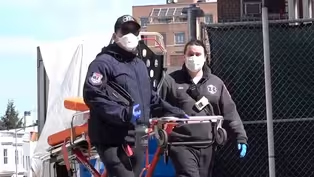
Clip: S4 Ep23 | 10m 24s | An emergency room doctor recounts his experience on COVID-19’s frontlines. (10m 24s)

Green Seeker: Catch and Release
Video has Closed Captions
Clip: S4 Ep23 | 6m 14s | A Salve Regina University professor catches birds in the name of science. (6m 14s)
Video has Closed Captions
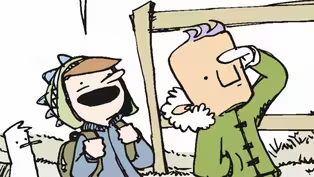
Clip: S4 Ep23 | 10m 32s | David Wright profiles the creator of the nationally syndicated cartoon Wallace the Brave. (10m 32s)
Providing Support for PBS.org
Learn Moreabout PBS online sponsorship
- News and Public Affairs

Top journalists deliver compelling original analysis of the hour's headlines.
- News and Public Affairs

FRONTLINE is investigative journalism that questions, explains and changes our world.





Support for PBS provided by:
Rhode Island PBS Weekly is a local public television program presented by Ocean State Media