
Rhode Island PBS Weekly 5/28/2023
Season 4 Episode 22 | 25m 40sVideo has Closed Captions
An in-depth look at nature and wildlife in the Ocean State.
Rhode Island PBS Weekly takes a deep dive into nature and wildlife in the Ocean State. First up, Pamela Watts meets the group responsible for rescuing 6,000 wild animals a year, from baby coyotes to bats. Then, a second look at the RISD Nature Lab, where snakes, skeletons, and microscope slides inspire art. Finally, we revisit a bird sanctuary dedicated to parrots.
Problems playing video? | Closed Captioning Feedback
Problems playing video? | Closed Captioning Feedback
Rhode Island PBS Weekly is a local public television program presented by Ocean State Media
Rhode Island PBS Weekly 5/28/2023
Season 4 Episode 22 | 25m 40sVideo has Closed Captions
Rhode Island PBS Weekly takes a deep dive into nature and wildlife in the Ocean State. First up, Pamela Watts meets the group responsible for rescuing 6,000 wild animals a year, from baby coyotes to bats. Then, a second look at the RISD Nature Lab, where snakes, skeletons, and microscope slides inspire art. Finally, we revisit a bird sanctuary dedicated to parrots.
Problems playing video? | Closed Captioning Feedback
How to Watch Rhode Island PBS Weekly
Rhode Island PBS Weekly is available to stream on pbs.org and the free PBS App, available on iPhone, Apple TV, Android TV, Android smartphones, Amazon Fire TV, Amazon Fire Tablet, Roku, Samsung Smart TV, and Vizio.
Providing Support for PBS.org
Learn Moreabout PBS online sponsorship(upbeat music) - [Announcer] Tonight on "Rhode Island PBS Weekly."
- [Pamela] If you find an injured, or abandoned critter in your backyard, who are you gonna call?
There's one place that can come to the rescue.
- The state of Rhode Island claims ownership to all the wildlife within its boundaries, and it's really the citizens of Rhode Island that are monitoring that, and helping them when they run into trouble.
- The Nature Lab is in this funny kind of a space, right?
It reads a little bit like a natural history museum.
So we have representatives from all of the kingdoms of life in our collection.
It's really about the exploration, and that the natural world doesn't just belong to science.
It belongs to everyone.
- What is it like, or what do you imagine at least that it's like for a bird that lives inside a cage for decades?
What kind of quality of life reduction do they experience?
- It's a great question.
Captivity is inherent cruelty for a wild animal, as it is for a human.
I mean, we are not, no being is meant to be stuck in a cage.
Parrots are flighted.
They have one of the most magical gifts that nature can give us.
They have, and we rob them of that.
(lively spirited music) (light music) - Good evening.
Welcome to "Rhode Island PBS Weekly."
I'm Pamela Watts.
- And I'm Michelle San Miguel.
Tonight, we're taking you around Rhode Island to look at how some folks in our backyard are putting animals and our environment first.
- We begin in Saunderstown, where nurture is taking over for Mother Nature.
As we found out on a recent visit, one nonprofit is the only place to go for injured, or abandoned wild creatures great and small.
(raccoon squeaking) - I think I wrote down in a journal in first grade that I wanted to be a vet when I grew up.
(Mariah laughs) Yeah, I've always loved animals.
- [Pamela] This is the fulfillment of that childhood dream.
However, Dr. Mariah Beck is no ordinary veterinarian, and this is not your typical animal hospital.
It's where the wild things are.
- I never know what's gonna walk in the door.
Last year, the clinic intook 200 species of animals.
- [Pamela] What might look like a puppy is really a coyote cub from an orphaned litter of four.
A raptor with a broken wing is examined.
A turtle is waiting for its shell to mend.
Raccoon kits have to be weighed.
(raccoon chirping) (animal vocalizing) Whether furry, or feathered, there are creature comforts here at the Wildlife Clinic of Rhode Island.
Dr. Beck says there are multiple ethical questions to be grappled with each day.
- Deciding, you know, releases, when something's ready for release, if it is viable for release, which things should be euthanized, which things should be treated, how far to push the medicine with a wild creature that's, you know, very stressed every time you're handling it.
- What do we have here?
- Oh, there was a bunny that was running in my parking lot.
- [Pamela] Patients are brought daily from concerned Rhode Islanders and animal control officers.
Dr. Beck and the staff care for 6,000 mammals, birds, and reptiles a year.
Most of the team is volunteer, specially trained to handle those born to be wild.
Assignments include getting baby squirrels that have fallen from the nest to nurse formula from a syringe.
Others patiently feed worms to days old hatchlings.
- [Volunteer] Hey, there.
There you go.
- [Pamela] In addition, the staff includes some 40 volunteers spread out across the state, people like Kristin Fletcher, who is a home rehabilitator.
The work requires education and experience, before receiving a permit from the Rhode Island Department of Environmental Management.
- We have to have our own private facilities approved by the state as well, that they are away from, you know, other people, and pets, and whatnot, so that it's quiet, and then you never raise a single animal.
So they will be raised as groups.
The law is that if you don't have trained and licensed individuals that every wild animal and bird that's injured, orphaned, not able to survive in the environment would need to be euthanized humanely.
- [Pamela] So Fletcher got the state training and licensing, and for many years she has brought wildlife into her house.
- I was always an animal person, and even as a kid, you know, preferred my pets.
My daughters found a squirrel after I think it was Hurricane Bob on the ground, and I looked and looked and looked for a place to bring him, and back then, there really wasn't any place to bring them.
- [Pamela] There are times Fletcher has had as many as 30 cottontail rabbits at once, like this baby bunny, that need to be fed three times a day.
But their stay is always temporary.
It is illegal for anyone to keep wildlife as pets.
- We're very careful about that, and that's part of the training to be a wildlife rehabilitator, because your goal is to release a wild animal back into the environment.
You don't want them thinking that it's good to hang around with humans, and so, you don't spend time petting them, or talking to them.
You provide them with what they need.
- [Pamela] Fletcher also has a bat cage in her heated garage, where she rehabilitates these winged mammals.
About a dozen years ago, it was illegal to rehabilitate them, but she says the state realized bats were getting a bad rap.
- So many animals do, and- - Because?
- Because they're at night, and certainly Bela Lugosi didn't help their cause any at all- - With "Dracula."
- Exactly, they all eat bugs.
(bat chirping) - [Pamela] Bats protect humans by eating enormous amounts of insects, which help ward off lethal diseases, such as West Nile virus and Eastern equine encephalitis.
Bats also assist farmers as natural pest killers.
- It's a male, big brown bat.
He was actually caught.
He caught his wing on the outside shutter of a home in Coventry, and was there for several days.
- [Pamela] Fletcher has another job.
She is also executive director of The Wildlife Clinic.
It too is a volunteer post.
There's a lot of people who would say, you know, "Oh, I love animals, but hey, there's a lot of wild animals, "circle of life."
Why is it so important to do this?
- We are, as humans, so responsible for a lot of the negative impact that we see here, and certainly worldwide.
There's less habitat.
There's just, you know, there's no open space.
Wildlife is forced into closer proximity to us, and there's lots of dangers associated with humans.
They're either hit by cars, or they hit our windows, or the tree is taken down where the nest is, or construction is happening, and nests are removed from, you know, roof lines.
- [Pamela] And Fletcher says humans do other things that result in a reduction in the number of songbirds.
- Certainly pesticide use is killing bugs.
So many of these birds eat bugs.
There's just so much out there that if we can either raise healthy animals and birds and release them back into the environment as breeding adults, it's a bit of a way of trying to correct, you know, those numbers dropping.
If we do nothing, you're just going to see those numbers continue to drop.
- [Pamela] Dr. Beck also sees efforts for wildlife survival as vital to the environment.
(raccoon chirping) - We're not only contributing to that individual life and kind of making that individual life better, and more humane, and more comfortable, and healed, and we're also contributing to the population, and the ecology, and the ecosystem of our, you know, local Rhode Island wildlife.
- [Pamela] While working to ensure Rhode Island wildlife doesn't become endangered, the clinic itself almost faced extinction last year, because it needed state funding.
The Wildlife Clinic is dependent upon it, as well as grants and donations to provide the food, medication, treatments, and the many specific cages necessary for recuperation.
The clinic works with the Department of Environmental Management to stabilize wildlife populations and monitor for rabies, bird flu, and other diseases.
- If animals start failing based on that, we'll be on the front lines of getting these animals in, so that, you know, we can make that determination, and then report to the state wildlife biologists.
- [Pamela] These coyote cubs will be vaccinated before being returned to a large forested area.
By law, the clinic has to release the animals within a mile of where they are found, and caretakers say the reward is in setting them free.
- The whole team here, you know, works so hard to bring every individual that we intake back out into the wild.
- Releases always make me cry, because it's happiness that they're gone, but the concern about what the environment holds for them.
- [Pamela] For Fletcher and the others who are devoted to their work at the clinic, it's a calling, a call of the wild.
- Some people would call it crazy, but commitment sounds much better, I think.
(Kristin laughs) (gentle music) (gentle music continues) - Next up, we take you to a museum of sorts here in Providence, where nature inspires art.
As part of our continuing "Window on Rhode Island" series, we visit an unusual part of the Rhode Island School of Design, where for the past 85 years students can find owls, skeletons, and mysteries only seen by microscope.
- Welcome to the Edna W. Lawrence Nature Lab at Rhode Island School of Design.
My name is Jenn Bissonnette, and I'm the interim director of the lab.
(whimsical music) So the building that we're in right now was RISD back in 1877.
So this beautiful brick building on Waterman Avenue was the entirety of the Rhode Island School of Design.
And in 1937, this became the studio space for one of the professors here, Edna Lawrence, hence the name of the lab.
(whimsical music) She taught nature drawing in this classroom, and her thinking was that if ever you were at a loss for what to do with one of your projects that nature could serve as endless inspiration in terms of color, and form, and pattern, and structure.
(whimsical music) Edna Lawrence, she definitely marched to the beat of her own drummer, thankfully, and there's stories that she actually at one point stowed away on a barge.
She was so eager to get to these other countries that she found any way that she could as a woman to like book her passage to get to these incredible destinations.
(whimsical music) When Edna left, there were about 20,000 specimens in the collection, and now we say there's somewhere between 90,000 and 100,000 specimens.
(whimsical music) The Nature Lab is in this funny kind of a space, right?
It reads a little bit like a natural history museum, except it is a little bit more like a lending library.
Most of the things in this collection don't have what we call a red dot on them.
If it's a red dot, you can't check it out, like my friend the bear here can't be checked out.
But other things you can check out, just like you would a library book.
Students take the specimens, they take them back to their dorm rooms, or their studio, and they're able to really explore them, and apply them into their projects in whatever way they want to.
(whimsical music) - Hello, I am Benedict Gagliardi.
I'm the staff biologist and collections manager at the RISD Nature Lab.
(whimsical music) In addition to all the preserved and dried specimens that we have, which is the majority of what we have here, there's been a long history of having live animals as well.
To my left here is our resident corn snake.
Hey.
(whimsical music) We do occasionally get found escaped pets, and things like that from various dorms on campus.
(whimsical music) Recently, we got a small snake, the same type of snake, a corn snake, and a plumber on campus walked into the lab with it in a cardboard box, and said, "I found this escaped in one of the dorms, "and thought you were the people to deal with it."
(Benedict laughs) (whimsical music) - So one of the interesting creatures we have here at the Nature Lab is our axolotl Gulliver.
They're actually critically endangered in their natural habitat, which is in Mexico City.
It's just one lake in Mexico City, where they're found naturally, hi, but they're very, very widespread globally, because they're used in labs for a number of different purposes, one of which is to study limb regeneration.
So these guys can actually lose an arm, or a leg, and grow it back again, and I thought, "Well, this will be interesting.
"I'll see if I can grow an axolotl."
And basically, we wound up with 24 full grown axolotls at the end, so we had a little bit of an axolotl overabundance, which we found them all really good homes.
(whimsical music) Okay, so let's head over to the bone room.
(whimsical music) So here we are in the bone room, and this is obviously a collection of bones, internal skeletons and exoskeletons.
(whimsical music) You know, one of the things that I find exciting about this collection is it probably is the space that highlights most what we're trying to do in terms of biomimicry.
Biomimicry is looking to the natural world for design solutions.
So thinking about the 3.8 billion years of evolution that life has been on this planet, there are a lot of pressures that have been solved by organisms over time that we as designers can look to for inspiration of how to solve some of the design problems that we're facing.
(playful music) So welcome to the imaging lab.
When Edna Lawrence left in 1977, the one thing that she said when she was going out the door was there'd be a whole new array of things to explore if we could see them at different scales.
(playful music) So for example, using the high speed video camera, there's some images on the screen back there that show how a dragonfly's wing, when it's raining, the water falls on the wing, beads up, and rolls right off of the wing.
(playful music) So then students came over, and used the scanning electron microscope to see what those micro-structures of the wing are that allow it to have that hydrophobic surface.
So the collection is always changing.
Students will send things from their travels as well, and we even sometimes get mystery boxes.
So that's always a fun opportunity, too, to know that the students are thinking of us, but also potentially to add to the collection.
(playful music) So the collection is always growing.
(gentle music) (gentle music continues) - Finally tonight, we introduce you to an exotic bird sanctuary that goes by the clever name Foster Parrots.
Tucked away in rural Hopkinton, it provides care to beautiful winged animals when their owners can't, or are no longer willing to care for them.
As contributing reporter Bill Bartholomew first explained in January of 2022, the sanctuary suffered a disaster which threatened its very existence.
Remarkably, it has survived, thanks to a community that cared.
- Well, it's, the frustration is that, you know, parrots are the third most popular pet in this country, excluding tropical fish.
But this is an enormous, enormous segment of the pet population, and yet, people are not recognizing that there's a problem with parrots, that there are unwanted parrots.
Quaker Parakeets actually have- - [Bill] Karen Windsor is the executive director of Foster Parrots, a Rhode Island based sanctuary for exotic birds that have been abandoned, or relinquished by their previous owners, who found the animals too difficult to care for.
Her husband, Mark Johnson, then a Boston area potter, wanted a bird for his studio, and rapidly became a caretaker for other birds in the late 1980s.
- He answered an ad and bought a blue and gold macaw for a companion in his pottery.
And the same day he bought this macaw and was walking down the walk, a neighbor came running up with her conure, and said, "Do you want, will you take this bird, too?
"I don't want this bird."
And so, he bought his first bird and rescued his first bird on the same day.
- [Bill] Windsor says that from there Johnson found himself on the receiving end of more and more exotic birds.
- It snowballed, you know?
People would see these birds, and they would say, "Hey, I have a bird that I don't want."
- [Bill] Johnson ultimately moved to a larger location, and formed Foster Parrots with the hope of adopting them out.
But for many of the parrots, that was not an option.
- A lot of these birds were wild caught, didn't like people, had behavioral issues, or medical issues that precluded them from adoption, and they were never gonna go anywhere.
And so, you know, that's when it's, you know, it began to dawn on us that, you know, we do need sanctuary.
There is a place for these birds.
- [Bill] So in 2007, they moved again to another location, the former Chickadee Farms in Hopkinton.
- My husband walked through this abandoned building, and he said, "This is it.
"We can do something here," which terrified me.
I knew how much work it was going to be.
- [Bill] And the hard work and generous donations paid off.
Over the years, Foster Parrots grew to take on hundreds of exotic birds, as well as a handful of other animals.
In 2014, fresh out of Tufts University with a degree in veterinary medicine, Danika Oriol-Morway began working with them as their director.
- As soon as I graduated, I was looking for a job.
I'm an animal welfare activist, and I saw posting for a parrot sanctuary, and I was not a parrot person before coming here.
I worked with wolves, and horses, and companion animals.
So I was like, "Okay, let's check this out, "and see if I can learn something."
- While Oriol-Morway says she has indeed learned a lot, she's also brought a public policy lens to Foster Parrots with examination of the global illicit bird trade, as well as domestic breeding here in the United States.
What is it like, or what do you imagine at least that it's like for a bird that lives inside a cage for decades?
What kind of quality of life reduction do they experience?
- That's a great question.
Captivity is inherent cruelty for a wild animal, as it is for a human.
I mean, we are not, no being is meant to be stuck in a cage.
Parrots are flighted.
They have one of the most magical gifts that nature can give us.
They have, and we rob them of that.
- [Bill] In their new environment, the birds thrived.
But on the morning of April 1st, 2021, Karen Windsor got some devastating news.
- I woke up at 5:00 a.m. to a phone call from one of my employees, who said that the building is on fire, and it's hard to describe the horror, because this is an old building, you know, not built for parrots.
- I live up in Boston, and I received a phone call probably shortly after 5:00 a.m. from Karen, and I'm sorry, I'm gonna try my best to get through this story, but she called me, and she's just crying, (birds squawking) and she says, "The building's on fire."
And I was like, "What?"
And she was like, "The sanctuary is on fire."
- [Bill] The building had suffered an electrical fire, and though its alarm system was wired directly to the local fire departments, the fire quickly spread through the facility.
- I've never experienced anything like that.
Visually, I couldn't even understand what I was looking at.
I didn't know if animals had gotten out, you know?
So it was this surreal experience of living your worst nightmare.
I mean, anybody who works in animal welfare, anybody who is responsible for a sanctuary, natural disasters, fires are the thing that keep you up at night.
- [Bill] The north wing of the sanctuary was lost, and with it, 96 birds perished.
(birds squawking) - Only two birds made it out of that section of the building, Rose, our scarlet macaw, and Buddy, a umbrella cockatoo.
But we lost all our cockatoos, our entire cockatoo colony, our Quaker colony.
It was devastating.
- In the months after the fire, members of the region's animal welfare community, as well as residents of the surrounding area, were very supportive.
What's this guy right here?
Who's this?
Today, Foster Parrots is rebounding, still providing shelter and care for over 300 birds.
- We've been slowly bringing the remaining building back up to, you know, where we can live in it, and function in it.
We already have been fundraising to rebuild the part that we lost, and that will hopefully start being built within the next year, and at that point, we are working on needing to renovate the rest of the building as well, because the conditions are still not, they're not good, you know?
It's still a chicken coop.
It's still an old building.
- [Bill] Karen Windsor remains grateful for all the goodwill the tragedy generated, and she hopes for many it is a wake up call.
- Well, what I would like the world to take away is, you know, we understand people's love for parrots, and we love them, too, but we don't have the right to take them away from the world that they were meant to live in, to extract them from the wild, and parrots as pets, putting a bird in a cage, this is an animal that was born to inherit the sky, and we take that animal, and we put it in a cage.
Wow.
I mean, that's not okay, and it's just, it's, you know, it's admiring that animal that, this beautiful, beautiful bird, and wanting to possess it, and I think what people need to do is instead, you know what?
Take your money and go to South America, and watch them fly free.
This is where they belong.
(gentle music) (gentle music continues) - And that's our broadcast this evening.
Thank you for joining us.
I'm Pamela Watts.
- And I'm Michelle San Miguel.
We'll be back next week with another edition of "Rhode Island PBS Weekly."
Until then, please follow us on Twitter and Facebook, and visit us online to see all of our stories and past episodes at ripbs.org/weekly, or listen to our podcast on your favorite streaming platform.
Thank you, and good night.
(light music) (uplifting music) (uplifting music continues)

Video has Closed Captions
Clip: S4 Ep22 | 8m 47s | If you find an injured or abandoned critter, go where the wild things are in Saunderstown. (8m 47s)

Video has Closed Captions
Clip: S4 Ep22 | 8m 58s | A bird sanctuary in Rhode Island has shown how compassion can overcome challenges. (8m 58s)
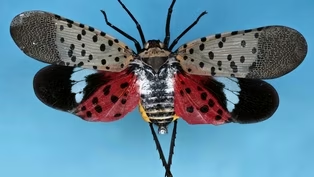
Window on Rhode Island: The Nature Lab
Video has Closed Captions
Clip: S4 Ep22 | 7m 3s | Explore RISD’s Nature Lab, where unusual creatures are the norm. (7m 3s)
Providing Support for PBS.org
Learn Moreabout PBS online sponsorship
- News and Public Affairs

Top journalists deliver compelling original analysis of the hour's headlines.

- News and Public Affairs

FRONTLINE is investigative journalism that questions, explains and changes our world.











Support for PBS provided by:
Rhode Island PBS Weekly is a local public television program presented by Ocean State Media