
Fiorella LaGuardia
Clip: Episode 3 | 3m 30sVideo has Closed Captions
Fiorella LaGuarida was a NY congressman and critic of Prohibition.
Fiorella LaGuardia was a Republican Congressman of New York and critic of the Volstead Act.
From
Problems playing video? | Closed Captioning Feedback
Problems playing video? | Closed Captioning Feedback
Funding is provided by Bank of America; PBS; CPB; The National Endowment for the Humanities; The Arthur Vining Davis Foundations; members of the Better Angels Society, including the Montrone Family through The Penates Foundation; and Park Foundation, Inc.
Fiorella LaGuardia
Clip: Episode 3 | 3m 30sVideo has Closed Captions
Fiorella LaGuardia was a Republican Congressman of New York and critic of the Volstead Act.
From
Problems playing video? | Closed Captioning Feedback
Where to Watch Prohibition
Prohibition is available to stream on pbs.org and the PBS app.
Buy Now
Providing Support for PBS.org
Learn Moreabout PBS online sponsorship- Never underestimate the need for young dopes to defy the conventional laws.
You want something, you want them to brush their teeth?
Make it illegal.
Make toothpaste illegal, and they'll be standing on the roof, brushing away.
It's natural to human beings.
I think it's a healthy thing.
- [Narrator] On June 19, 1926, six and a half years after prohibition became the law of the land, republican congressman Fiorello Laguardia of New York called 20 newspaper men and photographers into room 150 of the House office building in Washington, D.C.
No one had been a more vociferous critic of the Volstead Act.
He thought it intrusive, unfair to the poor, and above all, hypocritical.
To prove it, he stood before the cameras and mixed two perfectly legal products available in any neighborhood grocery: non-alcoholic near beer and malt extract, which, when allowed to ferment, would become illegal two percent beer.
He downed a glass of it, pronounced it not only delicious, but refreshing, pure, and wholesome, and dared anyone to stop him.
No one did.
When the director of the New York prohibition office warned that anyone who tried to duplicate Laguardia's stunt in his state would be arrested.
The congressman hurried home to stage the same demonstration at Kaufman's drugstore on Lenox Avenue in Harlem.
No prohibition agent turned up to arrest him, and when he asked the passing patrolman to take him in, the officer said it wasn't his job.
"The 18th amendment," Laguardia said, "was a disaster."
It had created contempt and disregard for the law all over the country.
- I think the thing that stands out for me most when I think about prohibition is, the law of unintended consequences.
That you just don't know what you're gonna get when you pass a law that seems pretty straightforward.
- What a stupid idea it was, that people actually thought you could get away with this, that you could actually ban alcohol, completely eliminate its usage in American society.
It's a preposterous idea.
- To me, one of the great lessons of prohibition is that the dry movement in the late 1920's had an opportunity to capitalize on its success, but modify the most egregious issues within the Volstead Act and the enforcement of prohibition, and refused to.
In their extremism, they eliminated all moderate support, and that's a really important political asset, that applies to a lot of different movements, that you gotta bend a little if you're gonna stay, if you're gonna keep what you've got.
'Cause if you don't bend, it's all gonna come crashing down around you.
Video has Closed Captions
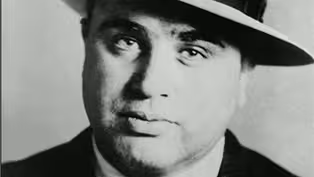
Clip: Ep3 | 5m 4s | Al Capone is finally caught by the government for failing to file income tax. (5m 4s)
Video has Closed Captions
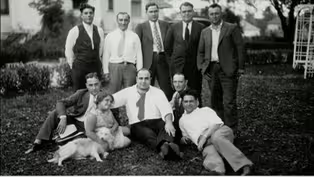
Clip: Ep3 | 7m 31s | On Feb. 14, 1929, seven men are gunned down and the public is incensed. (7m 31s)
Video has Closed Captions
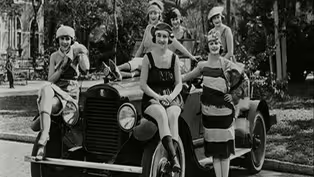
Clip: Ep3 | 6m 51s | Sexual mores start to change for Women during Prohibition. (6m 51s)
Video has Closed Captions
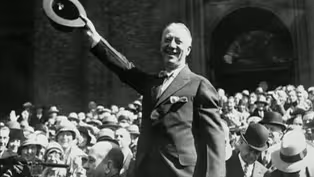
Clip: Ep3 | 12m 39s | The 1928 Presidental election was a bitter battle of dirty politics directed at Al Smith. (12m 39s)
Video has Closed Captions
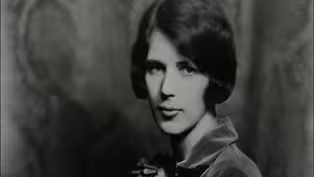
Clip: Ep3 | 7m 44s | Lois Long, pen-name 'Lipstick,' wrote about speakeasies for the New Yorker. (7m 44s)
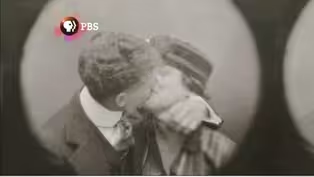
Margot Loines Wilkie: On Dating
Video has Closed Captions
Clip: Ep3 | 43s | Margot Loines Wilkie discusses the changing sexual mores of the 1920's. (43s)
Video has Closed Captions
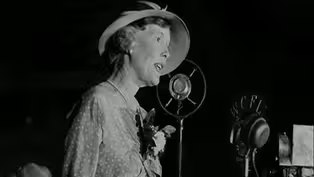
Clip: Ep3 | 10m 2s | Pauline Sabin was founder of the Women's Organization for National Prohibition Reform. (10m 2s)
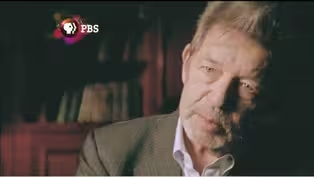
Pete Hamill: Defying Authority
Video has Closed Captions
Clip: Ep3 | 24s | Pete Hamill talks about defying authority. (24s)
Providing Support for PBS.org
Learn Moreabout PBS online sponsorship









Support for PBS provided by:
Funding is provided by Bank of America; PBS; CPB; The National Endowment for the Humanities; The Arthur Vining Davis Foundations; members of the Better Angels Society, including the Montrone Family through The Penates Foundation; and Park Foundation, Inc.