
Market to Market - April 10, 2026
Season 51 Episode 5134 | 26m 45sVideo has Closed Captions
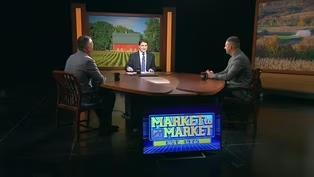
Breaking down the commodity markets with Ross Baldwin and Jeff French.
On this edition of Market to Market ... Prices at the co-op remain high as the Strait of Hormuz stays closed. Low snowpack sets up a potential for drought in the west.,Sorting the livestock market in an extended discussion. And, breaking down the commodity markets with Ross Baldwin and Jeff French.
Problems playing video? | Closed Captioning Feedback
Problems playing video? | Closed Captioning Feedback
Market to Market is a local public television program presented by Iowa PBS
Market to Market - April 10, 2026
Season 51 Episode 5134 | 26m 45sVideo has Closed Captions
On this edition of Market to Market ... Prices at the co-op remain high as the Strait of Hormuz stays closed. Low snowpack sets up a potential for drought in the west.,Sorting the livestock market in an extended discussion. And, breaking down the commodity markets with Ross Baldwin and Jeff French.
Problems playing video? | Closed Captioning Feedback
How to Watch Market to Market
Market to Market is available to stream on pbs.org and the free PBS App, available on iPhone, Apple TV, Android TV, Android smartphones, Amazon Fire TV, Amazon Fire Tablet, Roku, Samsung Smart TV, and Vizio.
Providing Support for PBS.org
Learn Moreabout PBS online sponsorship>> Coming up on Market to Market.
Price is at the co-op remain high as the Strait of Hormuz stays closed.
Low snowpack sets up a potential for drought in the West.
Sorting the livestock market in an extended discussion.
As we break down the markets with Ross Baldwin and Jeff French next >> [MUSIC] >> I wouldn't be here without my customers.
>> Yeah, I'd like to thank the customers there.
They're very dear to our hearts.
>> It's about the people that you're working with and the relationships that you have.
>> Thank you, thank you, thank you.
>> Thank you from the bottom of my heart.
>> [MUSIC] >> Tomorrow for over 100 years, we've worked to help our customers be ready for tomorrow.
>> [MUSIC] >> Trust in tomorrow.
Information is available from a Grinnell Mutual agent today.
>> This is the Friday, April 10th, edition of Market to Market, the weekly Journal of Rural America.
>> Hello, I'm Paul Yeager, the last of the data prior to the conflict in Iran is making its way through the economic news cycle.
Orders for long lasting items were off for a third consecutive month in February.
At 1.4%.
The Federal Reserve's preferred inflation reading.
The PCE added 4/10 of a percent to the monthly mark, with the annual snapshot adding 2.8%.
The consumer price index was also higher by 9/10 of a percent and up 3.3% in the year over year.
Reading taken in March.
Now, this data will now have to account for higher energy prices, even as the White House agreed to a two week ceasefire in Iran.
While the Strait of Hormuz remains closed effectively to shipping.
Now, President Trump threatened to annihilate Iran on Monday, but then reversed course short of his Tuesday deadline.
The Pentagon has declared victory in the war, but proposals put forth by Iran and the United States have little overlap.
Here's Peter Tubbs.
>> Oil prices remain high as Iran maintains its right to charge tolls on traffic through the Strait of Hormuz, and suggested Thursday they have landmines in the waterway.
Consumers will continue to pay high prices for gas and diesel, as distributors now have high priced inventories to work through.
Fuel prices may vary from state to state and town to town.
A few ships have reportedly made passage through the strait, but shipping volumes remain 90% below the traffic from before the war.
According to the United Nations, 30% of the world's urea, potash, ammonia and phosphate move through the channel that is 21 miles wide at its narrowest point.
>> So some they're facing this cost crunch now.
Others know the cost crunch is coming.
And it's also the case here.
I'll take us back to diesel again as well.
There's again another case where some farmers would have preordered their diesel for the year.
Others have not.
So we're catching some farmers, but not all.
Like I say, in this cost squeeze right now.
But all of them know that this thing is likely going to last into their planning for not only this year's crop, but next year's crop.
>> Military analysts estimate the cost of the war at over $30 billion, according to the Military Times.
The first six weeks of the war with Iran has resulted in the deaths of 13 American service members and over 380 injuries.
For Market to Market, I'm Peter Tubbs.. >> This coming week, the National Weather Service is predicting 1 to 4in of rain across eastern portions of the Southern Plains, Midwest and Northeast.
Now the heaviest totals are expected in eastern Oklahoma and Arkansas through the Mid Mississippi Valley into eastern portions of the upper Midwest.
But the situation in Colorado and points west is already hotter and drier than normal.
The winter recreation season had an early shutdown, and that's just the beginning of the issues that are unfolding.
David Miller reports.
>> Snowpack readings reveal this past winter has been low on snow and high on persistent or expanding drought across the west and southern Plains.
As of this week, U.S.
Drought Monitor data reveals over 50% of the country is in a moderate or worse drought.
Precipitation across the Midwest has alleviated some of the problem across the Corn Belt from Iowa through Ohio.
However, conditions continue to get worse in the west.
>> The heat out west has truly just been ridiculous.
You know, I'm based here in Fort Collins, and we set a new monthly March record by ten degrees Fahrenheit.
So our previous was 81 degrees.
We hit 91.
Previous to that, we hadn't seen a 90 degree day until May.
>> Mountain snowpack conditions remain well below normal despite this week's precipitation across higher elevations.
Currently, the snowpack in the Pacific Northwest is 50% below normal.
The Southwest and southern Plains are in the grip of a six year old drought.
>> Really?
March has just made the story so much worse.
The heat that we saw in March, particularly in the western US, was very unprecedented and honestly bordering on edge of what I think scientists would even think would be possible at this time of year.
So truly, that has just fully changed the situation.
>> For Market to Market.
I'm David Miller.
>> Next, the Market to Market report.. >> Following USDA's report of more wheat carryout and no changes to the soybean and corn carry, the market turned back to war and weather as the primary movers for the week ending April 10th.
The nearby wheat contract lost $0.27 and the May corn contract fell $0.11.
Great crush demand remained to lead the weaker export story in the soy complex.
The May soybean contract added $0.12, while May meal improved by 1660 per ton.
May cotton expanded by $2.30 per hundredweight.
May class three milk futures declined $1.
$0.17.
The livestock market was mixed.
June cattle improved.
Two 87th May feeders took off 390 and the June lean hog contract weakened by $0.75.
In the currency markets, US dollar index fell by 132 ticks.
May crude oil fell by more than 12%, or 1374 per barrel.
Comex gold improved $97 per ounce, and the Goldman Sachs Commodity Index was off by more than 21 points to settle at seven 1720.
Here now to lend us their insight on these and other trends, a regular market analyst, Jeff French and Ross Baldwin.
Good to see you both.
>> Hey, Paul, good to see you.
>> Thanks for having me.
>> All right, Jeff, this wheat story was not going was really going to be something I thought we'd be talking about.
Then this USDA report yesterday.
Why did it move the market so much?
>> Well, I think it just reinforces the fact that not only here domestically but globally, we have plentiful supplies, 930 million bushels in the carryout.
That's 80 million bushels more than the this report last year.
But then you also had a big change in the forecast.
And you have some major good rain coming to a good part of wheat country.
And we're in the business season of wheat right now.
April and May.
This is where they get, you know, to add their bushels right now.
So you also had the wheat run up to, you know, two, three year highs with the war premium.
The funds were long for the first time in four years.
But then you just, you get to an area where farmers were hedging.
There was a lot of old crop moved on the rally.
And we've seen the forecast change.
That's what I think was happening here this week.
>> And the supply story has been the one.
That's why it seems so out of place to see that rally that we had recently to come back into this market.
So can this market sustain a continued volatility?
I mean, there's nothing it can do about volatility in the market.
But the weather can it handle this weather volatility.
And how does anyone make sense of it right now.
>> Well I mean we had you know we're coming down here in the last couple of weeks.
We're 60 $0.70 off the highs.
You know I'm not looking to sell this market.
I like to sell strength.
And we were very active in the first week of the conflict.
But now we're into, you know, five weeks ago.
I mean, that's kind of old news if you get it, you know.
So I think the volatility might continue.
But if you look at the VIX the volatility index it's actually below where it was trading at prior to the conflict.
It's below 20 right now.
So it can be put back in really quick.
But it's it feels like we're into a quieter time right now.
>> Let's talk about weather for a minute though.
You mentioned we just had the story about the rain potential that's coming to certain areas, certain areas, not all the areas going to get to you in a minute, Ross, because this is this is tied into cattle in a question.
What does it mean in Colorado, western Nebraska, all the way to the west, up to the Pacific Northwest on a crop story with this drought?
>> Well, they're hurting, there's no question.
And if you can't irrigate, they might have to be making some crop choices.
But yeah, it's it's been affected and it doesn't look like it's going away.
But the places that get rain is going to benefit greatly.
>> All right Ross so what does the drought story mean in the livestock market as a whole?
>> If the drought were to continue and it it continues to expand, but if you just take it at face value where it is today, what it means for the livestock industry is not much for herd expansion.
And it's the craziest thing to talk about at this point in the ball game, where we're at in these cattle markets, where actually making new all time highs today as we speak, both cash and futures.
And to sit here and say that we're now looking down the barrel of not seeing herd expansion at this point in the bull market.
It's it's honestly how I've actually summed it up to some people.
It's kind of like a double edged sword that the industry has never seen before, because obviously we've never been to these kinds of record high prices.
The herds at a 75 year low.
You think expansion.
We keep thinking that it's going to come, but all we've done is kick the can down the road.
And that's what it looks like right now with where the drought sits.
>> We've moved animals from places to place with drought, whether it was in Texas, Oklahoma, it goes to Nebraska or it goes to Montana.
Can we continue to shuffle around to get around this story for the summer?
>> Not really.
I don't think you can.
And and one thing that has continued to string this along has been lately, the increase of days on feed, which has pushed carcass weights to where they have.
You've got steer carcass weights running 40 pounds above a year ago.
As an industry, we've been running 25 to 30 pounds heavier than a year ago, but we've.
And with packers slaughtering less cattle on a weekly basis, slaughter is consistently running 10% lower year to date right now.
So we've.
We've continued to kind of keep production steady right now, but weights are hitting a plateau right now.
And so with less supplies, getting ready to hit the market and weights starting to plateau, the rubber is going to, there's still a point where the rubber is going to meet the road.
And we are we are going to continue to experience tighter beef production as we head through 2026.
>> It's not that I don't pay attention to what you say, but you and I have talked about this.
It's seeming the same talking points for the last year.
And every time you think it's going to end, it doesn't.
Is this ever going to end?
>> At some point it will.
Right?
All good things come to an end.
There's no cure for high prices like high prices.
But yeah, you and I, we've talked about it and I feel like a broken record as I've been coming on here for a couple years now.
And I swear, every time I come on here, there's one big move up or down.
It seems like on these Fridays when we record.
But there will come a point.
And so far we haven't got there, but there will come a point where you incentivize herd expansion.
Now, whether that's because the weather cooperates or from a price perspective that's encouraged, or there will come a point where via demand because of high prices.
But so far the consumer has been more resilient than anyone could have ever imagined in the US.
And demand demand is not a problem.
And it hasn't been a problem.
Demand actually continues to remain more robust than we could imagine.
>> Mother's day right around the corner.
Best demand time of the year.
>> And then it picks up and it starts to we start to grill a lot more.
We're going to get back to more of this livestock discussion because you mentioned the cash and the futures I want to get into, but the demand is still a huge story in the corn market.
Yeah.
Is that the only thing propping us up right now?
>> Well, you had the funds get long 240,000 contracts in front of the war.
I mean, that was a major reason for the rally.
But yeah, demand is great.
We got 3.3 billion bushels in exports.
You know, on the report they got 6.6 billion bushels on feed and residual.
You know, that seems like a big number with the cattle numbers where they're at.
But all in all, you know, market's holding in there.
But 2.1 billion bushels carry out.
That's 600 million more than this time last year.
So it is going to probably cap rallies.
I mean we we got aggressive there the first week of the conflict and moved a lot of old crop and new crop.
>> You mentioned the volatility index.
What's it look like then for the corn market compared to like the wheat market.
>> Well I mean we should firm going into planting season in my opinion.
And then it's up to Mother Nature as always.
I mean we do have plentiful supplies but that can change.
Hurry change quickly depending on what the weather brings.
>> Well, okay, not weather, but I had somebody ask me this.
Want to make sure I asked you.
This is $120.
Crude oil lead to $5 corn right now because you mentioned the weather story.
But let's talk about the oil story.
>> It led to 4.98, which is pretty darn close to $5.
And you know, we traded up there for two weeks.
I mean, we traded 4.95, 4.97 multiple times.
And we just could not take that out.
I mean, it's it's like a glass ceiling up there.
There was a lot of producers trying to sell for $5, you know, on the button.
>> What were you telling people at that point?
>> We were advising sales as well.
I mean, when you look at you, you can't ignore the fact over the last couple of weeks, corn has started to divorce itself from the crude oil story.
And it goes back to we've got a 2.1 billion bushel corn carryout.
Jeff brought up the FSR number.
It's likely on the high side of things, but $5 corn.
I mean, that 4.98 level was likely close enough given the 2.1 billion bushel old crop carryout.
There's not a shortage of new crop corn acres coming at us.
So if Mother Nature cooperates and we have a trendline yield, we're looking at a big production again next year.
>> When Wall Street wants your product, sell them some.
And that's exactly what we.
Reward the rally.
>> Reward the rally.
I've heard that a time or two.
I think that's a good.
But how do you.
In spite of every.
The.
I'll go back to the word, I guess the word of the show this week is volatility.
How do you know that?
That is the market talking to me right now and not just a half of a pause before we run up higher.
>> Well, we'll have to see.
But the corn market definitely divorced itself from the crude.
I mean prior to the cease fire, the previous two weeks crude was up $20 and corn was down $0.25 from the highs.
So can it turn on a dime?
Sure.
But I think we got to see what happens Saturday in Pakistan with the meeting.
So Sunday night could be volatile.
>> On the livestock side of It's always easy to say with feeders, but I mean from.
You have to kind of work both sides of the the street there with your clients that you're trying to help that way.
But how about those that maybe didn't lock in anything to feed?
And they're looking at this, this high run up.
Are they just having to wait it out or are they looking for alternatives yet when it gets to $5 on corn.
>> The, the saving grace for, for cattle on feed right now, if if, if feed wasn't locked in has been that the old crop contracts given the carry that the market is in right now.
Yes.
You had December corn get up to 4.98.
But the nearby I mean we're in a we're in a big carry.
So the old crop of where guys are more focused on buying feed needs right now has not really got that crazy priced.
When you factor in what corn basis has been.
So corn basis has been pretty weak across the country.
So from a from a cost of gain standpoint, it's still very manageable.
So you've still been looking at 450 or less cash corn up here in the northern feeding regions.
And with a 240 now 250 type cash market, your cost of gain has really been pretty much irrelevant.
But that said, the cheaper cost of gain that we're still seeing across the industry, coupled with $2.50 fat cattle.
It's all it's all factored into what these feeder cattle costs that are getting placed and going on to feed right now.
So yes, there's a cheap cost gain.
We've got big cash.
But the margins, I mean margins have they're very, very tight right now across the cattle feeding sector.
So and that's all because of the optimism there is.
And that that's all figured into what feeder cattle are bringing right now.
>> And again those tight margins have been there for quite a while now.
>> They have been for sure.
But we're really starting to see over the last 6 to 8 months, those margins across the the fat cattle finishing sector, they've really been squeezed down on just because of what feeder cattle have done there for quite a while.
Feeders outpaced fat cattle by so much that with what the.
The breakevens got so high.
I mean, you got to think, I mean, most of the industry right now, it's well over a $2.40 break even of cattle that are on feed in feedlots.
So breakevens are high right now.
So I mean, we definitely need to see this upper.
Two 4250 type cash.
>> Packer margins in the red.
I mean, I we won't see that long.
I mean, they, they do not like that.
>> But it's been a yo yo.
I mean the Packer margins for the better part of the last three years have been negative.
They just recently got positive again.
They had about three weeks where they were in some positive territory.
But now over the last week, they've quickly sunk right back into the red, likely over $100 a head negative.
It's just a tricky situation for the Packers right now because of the supply side of it.
But 26 I mean it's still a pretty bleak outlook for the packing industry.
It's going to be difficult for them to to not run in the red right now.
But no question, the longer they run in the red, coming off the amount of years that they have been, it's the more likelihood you you start to hear chatter of maybe another announcement around a plan or something going on.
Because like Jeff said, they don't like it and they're not going to do it forever.
They've done it longer than we've seen.
So something to keep your eye on as a cattle producer.
>> Let's move over to beans for a minute with this demand story, because we talk about crush, we don't have the exports.
There's meetings on weekends, there's meetings in six weeks, there's four weeks.
There's acres discussion.
What's the headline for you right now?
In in beans.
>> Beans have just been absolutely sideways since the limit down day on March 16th.
I mean, we've just been three weeks of just moving.
I think every day we've traded in May 1160.
I mean, we just have not moved.
And you're right, the market is waiting for that meeting on May 15th with Trump traveling to China.
But you know, we'll have to see what develops here over the weekend.
I just don't anticipate a meeting happening.
If we're in a conflict still.
But you know, funds are long.
They want to see higher prices on acres.
I think 84 million is the low print of the year.
I think beans will gain some acres.
>> Even over what was released here a couple of weeks ago.
>> Yeah, I think that will be the low print in my opinion.
I think beans will gain some acres.
I mean, 1150 beans.
It works especially well for fertilizer.
Prices for corn are.
>> Well, okay.
It's also the only the 10th of April.
And we talk about rain.
You can always get the crop in.
At what point does the weather, what's the biggest weather premium opportunity for soybeans?
>> Well, I you know, they want to plant the soybeans early.
So if this thing does continue, I mean, it can change quickly.
But I think the rains right now are probably more beneficial.
I mean, but I think you get into the third week of April and we're still slow.
I think you could see some things change quick.
>> More beneficial over problematic.
>> Right now.
Yes.
>> Okay.
Let's talk.
I didn't I kind of skipped over the ethanol side of this, but what's the soybean oil story in all of this?
Because it had been part of it.
Now it's not a part of it, but with crude oil is there you mentioned there's some divorces going on.
Is there one right here?
>> Well, what what the trade was doing.
They they were buying the oil, the soybean oil and selling the meal.
And they did that trade for months.
And here in the last week they've they've unwound that trade.
And that's why you saw Miele really.
I mean Miele was up 16, $18 here today trading at about a one month high.
So it looks like they're unwinding that.
But again it's going to be well supported with $100 crude.
I mean it's just it's going to be supported.
>> And you had the manage my record long soybean oil recently.
So I mean these are some big positions that they've got on.
>> What about the headline this week of China and their hog industry.
Not necessarily interested in US meal anymore.
What's that doing.
>> China's hog industry.
I mean I believe the prices are at the lowest levels they've been at in the last 15 years.
They've got an overabundance of of hogs right now and hog production.
So it's a that's the, I'd say that's one of the bigger red flags for the hog industry, the hog industry domestically.
Right now, we're actually in pretty good shape in the US margin.
I mean, the profitability is pretty good across the industry.
We're seeing strong demand out of Mexico.
We've seen an increase in in exports to Japan as Japan's had a ban on Spain due to the ASF over there.
So there is some positives right now across the hog industry from a domestic standpoint.
But you can't ignore the the Chinese stories that are floating around out there with their hog markets.
>> I'm going to pull from the depths here of something you said, and I have to reach into my pocket for this question for Ross, I wrote Futures and Cash.
You kind of talked about it earlier, specifically in the cattle market.
Cash is always king.
But you've also mentioned futures.
We've been having some issues with the two, which is king right now.
>> Cash is absolutely king across both fats and feeders right now.
But what is extremely interesting is you go back to to last week, you had the previous week, cash had we'd been stagnant around 235.
We came into the week.
I mean, there was some optimism that cash was going to be a little bit higher.
And then futures rocketed higher before cash even started trading a week ago And heading into last Thursday, right before Good Friday, you had futures sitting around April, futures around 245, which was ahead of First Notice Day, which was this past Monday.
And that was against a previous week's cash of 235.
So we were staring at a -$10 basis essentially, and cash screamed higher, traded 10 to $11 higher.
That was last week, one of the largest week over week increases that we've seen across the industry.
So last week we end the week at 245 to 246.
Today as we're recording this, cash is very quiet to end the week, but there has been some 250 cash that has traded to a regional in the north.
And there is a lot of Packer interest still today.
So if you factor in what cash did this 250 today, which is not the average for the industry for the week because we don't know where it's at.
But the 250 today and what cash did last week, we've seen a $15 increase in the cash markets really in a one week's time, because it hasn't even been two weeks because it was last Thursday when cash jumped $10.
So in about one week time frame, we've seen a $15 jump, which is why futures have done what they did to end the week today.
And we're making new contract highs across fat cattle.
>> And that's it.
We out, we're out.
We're done.
That was a lot.
I have to take a breath.
We have to take a breath.
Thank you very much.
Thanks.
Baldan.
Jeff French.
We'll let you get your answer here in a minute.
All right.
All right.
Thank you both.
And you have been watching the analysis portion of the program.
In a moment we will continue that discussion in what we call Market Plus.
So here's how you find their discussion.
Search Market Plus with Jeff French and Ross Baldwin.
Wherever you get your podcasts.
You can also go to our website of markettomarket.org to listen.
Now, those of you who subscribe to our YouTube channel have long known that's a place to find our program.
Market Plus and other offerings.
If you turn on notifications from us, you get the content first.
Subscribe now at YouTube.com Market to Market.
Next week, the dairy industry finds balance as new tastes churn.
Fresh optimism.
Thank you so much for watching.
Have a great week.
>> [MUSIC] [MUSIC] [MUSIC] >> Market to market is a production of Iowa PBS, which is solely responsible for its content >> [MUSIC] >> I wouldn't be here without my customers.
>> Yeah, I'd like to thank the customers.
They're they're very dear to our hearts.
>> It's about the people that you're working with and the relationships that you have.
>> Thank you, thank you, thank you.
>> Thank you from the bottom of my.
>> Heart.
>> [MUSIC] >> Tomorrow for over 100 years, we've worked to help our customers be ready for tomorrow.
Trust in tomorrow.
Information is available from a Grinnell Mutual agent today >> This week on.
 New
NewMarket Plus with Jeff French and Ross Baldwin
Video has Closed Captions
Clip: S51 Ep5134 | 12m 35s | Market Plus with Jeff French and Ross Baldwin (12m 35s)
Providing Support for PBS.org
Learn Moreabout PBS online sponsorship
- News and Public Affairs

Top journalists deliver compelling original analysis of the hour's headlines.

- News and Public Affairs

FRONTLINE is investigative journalism that questions, explains and changes our world.












Support for PBS provided by:
Market to Market is a local public television program presented by Iowa PBS